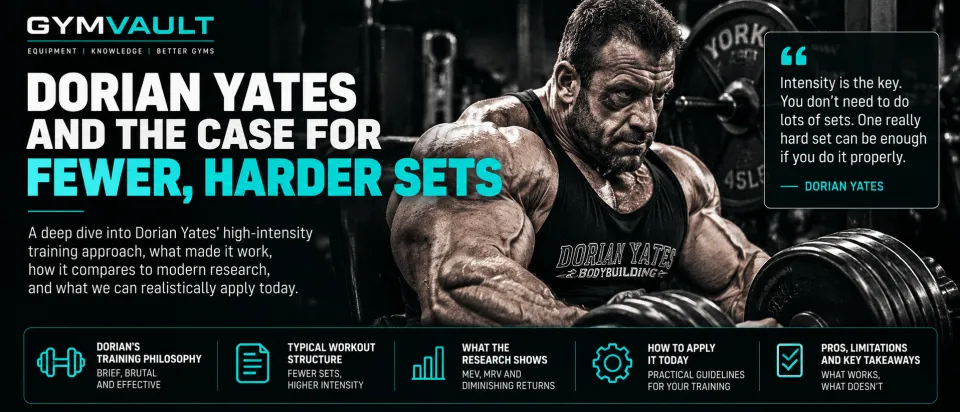
In the early 1990s, the most successful bodybuilder in the world trained for about an hour, four days a week. Dorian Yates won the Mr. Olympia title every year from 1992 to 1997 (Merritt, 2025). The physique was enormous. The workouts, on paper, were not.
That contrast has made Yates a reference point in every argument about training volume. Supporters of low-volume training point to him as proof that a few very hard sets are enough. Critics point out that one exceptional athlete proves very little. Both are partly right. This article separates what Yates did from what the evidence can tell us.
What his training actually looked like
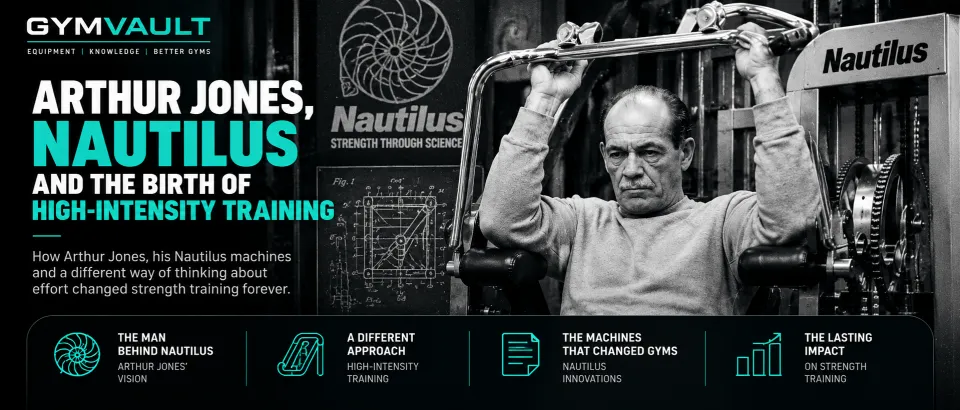
Yates trained at Temple Gym in Birmingham and built his approach on the high-intensity ideas of Mike Mentzer and, before him, Arthur Jones. According to a detailed account of his training by the bodybuilding writer Greg Merritt (2025), by his Olympia-winning years his method looked like this:
- Four sessions a week, on a split that trained each body part once every seven days: shoulders, triceps and abs; back; chest and biceps; legs.
- One to three progressive warm-up sets before each exercise, the last of them fairly demanding.
- One all-out working set per exercise, usually aimed at failure in about six to eight repetitions, sometimes extended with forced repetitions, rest-pause repetitions or a drop set.
- Several exercises per body part. Smaller muscles such as the biceps received about three or four working sets in the week, and the back about six to eight.
- Plenty of machines alongside free weights.
The detail in the fourth point is easy to miss. "One set" described each exercise, not each muscle. A large muscle group such as the back still received six to eight sets a week that were taken to, or beyond, failure.
Yates's own explanation of why one working set was enough is often quoted: "If you feel you can attempt a second set, then you couldn't have been pulling out all the stops during the first set" (quoted in Merritt, 2025).
His machine choices left a mark on the industry. Life Fitness says the Hammer Strength Iso-Lateral D.Y. Row was developed in collaboration with Yates and originally created just for him (Life Fitness, n.d.). It recreates the underhand row towards the hips that he favoured, on independent arms.


Why one champion's routine proves little
A training method used by a champion is a story, not an experiment. Elite results depend on many things at once: genetics, years of accumulated training, nutrition, sleep, coaching, and, in professional bodybuilding of that era, performance-enhancing drugs. There is no way to tell from one career which of those things did the work.
There is also survivorship. We hear about the lifter whose approach coincided with six titles, not about the many who trained the same way and never competed. That does not make Yates's method wrong. It means we need controlled studies to know how well the method works for ordinary people.
What the research says
Weekly volume
The best-supported finding in hypertrophy research is a dose–response relationship between weekly sets and muscle growth. A meta-regression of 15 studies found that each additional weekly set was associated with a small further increase in muscle size, and that the difference in percentage gain between higher- and lower-volume conditions averaged 3.9% (Schoenfeld et al., 2017).
A larger 2026 analysis of 67 studies and 2,058 participants confirmed that gains in both muscle size and strength rise with weekly volume, but with diminishing returns, and that the returns diminish much faster for strength than for size (Pelland et al., 2026). The 2026 American College of Sports Medicine position stand concluded that muscle growth is enhanced by higher volumes of at least ten sets per muscle per week (Currier et al., 2026).
There is also a ceiling to what extra volume can do. A review of trained young men found no difference between moderate (12–20 weekly sets) and high (more than 20) volumes for the quadriceps or biceps, though high volume did favour the triceps (Baz-Valle et al., 2022).
Low volume and strength
For strength, low volume performs surprisingly well. In a trial of resistance-trained men, one, three and five sets per exercise, three times a week, produced similar gains in squat and bench-press strength over eight weeks, while muscle growth favoured the higher volumes (Schoenfeld, Contreras et al., 2019). A systematic review found that a single hard set two to three times a week produced "suboptimal, yet significant" gains in squat and bench-press strength in trained men (Androulakis-Korakakis et al., 2020).
Frequency
Yates trained each muscle once a week. Early pooled evidence suggested that training a muscle twice a week grew it more than once a week when total volume was the same (Schoenfeld et al., 2016). A larger update of 25 studies then found no significant difference between frequencies when volume was equated, concluding that people can choose a weekly frequency based on preference (Schoenfeld, Grgic and Krieger, 2019). The 2026 meta-regressions agree: frequency appears to matter little for muscle growth once volume is accounted for, but more frequent practice does help strength (Pelland et al., 2026).
Effort and failure
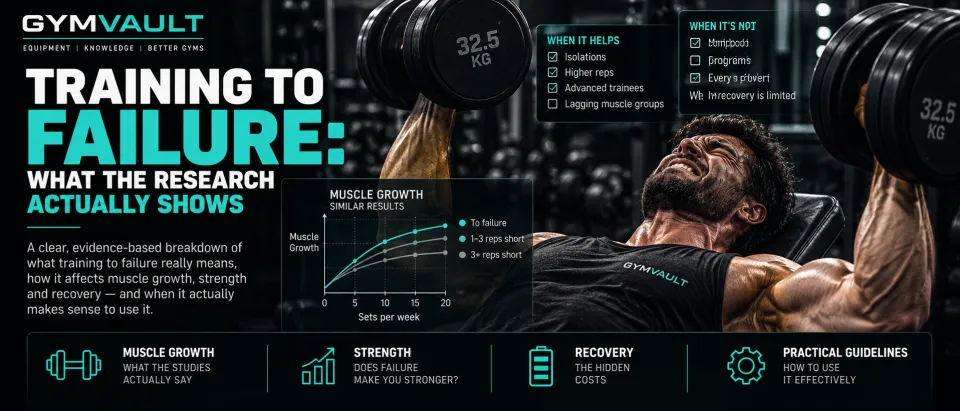
Where Yates was most convincing was effort. Meta-regression evidence suggests that muscle growth increases as sets end closer to failure, while strength gains are similar across a wide range of effort levels (Robinson et al., 2024). Going all the way to momentary failure, however, has not been shown to beat stopping just short of it for muscle growth (Refalo et al., 2023).
Failure has a cost. When trained men performed sets to failure, neuromuscular performance took longer to recover, up to 24 to 48 hours, than with protocols that stopped short, even when total volume was equal (Morán-Navarro et al., 2017). Once-a-week training of each muscle gave Yates plenty of time to recover from that cost.
Where Yates's approach sits in the evidence
Put the pieces together and Yates looks less like an outlier and more like someone who found an efficient corner of the evidence:
- His weekly sets per muscle, roughly three to eight very hard sets, sit at the low-to-moderate end of the ranges studied. That is enough to build muscle, but research suggests most people would grow faster with somewhat more, up to a point.
- His effort was at the extreme end, which the research supports for hypertrophy, with the caveat that true failure is optional.
- His frequency of once a week per muscle appears to be a reasonable choice for muscle growth when weekly volume is adequate.
- His recovery was protected by design. High effort, low volume and long gaps between sessions for the same muscle go together.
Building a Yates-style week with machines
If short, intense sessions suit you, the research suggests a few adjustments that keep the spirit of the method while improving the odds:
- Keep the warm-ups. Ramp up over one to three sets so the working set is genuinely your best effort.
- Use one or two hard working sets per exercise. A second set is often worth it when size is the goal.
- Count sets per muscle per week. Aim for at least six to ten hard sets for the muscles you most want to grow, spread over two or three exercises.
- End sets within a repetition or two of failure. Save true failure, forced repetitions and drop sets for the last set of an exercise, and use them on machines where you can stop safely.
- Train each muscle once or twice a week. Choose whichever you will keep doing for months.
- Write everything down. Load and repetitions on every working set are the only reliable way to know you are progressing.
Machines suit this way of training well. They let you push close to failure without a spotter, and plate-loaded machines in particular make small, steady increases in load easy to apply.
References
- Androulakis-Korakakis P, Fisher JP, Steele J. The minimum effective training dose required to increase 1RM strength in resistance-trained men: a systematic review and meta-analysis. Sports Med. 2020;50(4):751–765. doi:10.1007/s40279-019-01236-0
- Baz-Valle E, Balsalobre-Fernández C, Alix-Fages C, Santos-Concejero J. A systematic review of the effects of different resistance training volumes on muscle hypertrophy. J Hum Kinet. 2022;81:199–210. doi:10.2478/hukin-2022-0017
- Currier BS, D'Souza AC, Singh MAF, et al. American College of Sports Medicine position stand. Resistance training prescription for muscle function, hypertrophy, and physical performance in healthy adults: an overview of reviews. Med Sci Sports Exerc. 2026;58(4):851–872. doi:10.1249/MSS.0000000000003897
- Life Fitness. Hammer Strength Iso-Lateral D.Y. Row (IL-DRW), product page. Accessed 2026. lifefitness.com.au
- Merritt G. Dorian Yates workout: complete training guide. The Barbell. 17 September 2025. thebarbell.com
- Morán-Navarro R, Pérez CE, Mora-Rodríguez R, et al. Time course of recovery following resistance training leading or not to failure. Eur J Appl Physiol. 2017;117(12):2387–2399. doi:10.1007/s00421-017-3725-7
- Pelland JC, Remmert JF, Robinson ZP, Hinson SR, Zourdos MC. The resistance training dose response: meta-regressions exploring the effects of weekly volume and frequency on muscle hypertrophy and strength gains. Sports Med. 2026;56(2):481–505. doi:10.1007/s40279-025-02344-w
- Refalo MC, Helms ER, Trexler ET, Hamilton DL, Fyfe JJ. Influence of resistance training proximity-to-failure on skeletal muscle hypertrophy: a systematic review with meta-analysis. Sports Med. 2023;53(3):649–665. doi:10.1007/s40279-022-01784-y
- Robinson ZP, Pelland JC, Remmert JF, et al. Exploring the dose–response relationship between estimated resistance training proximity to failure, strength gain, and muscle hypertrophy: a series of meta-regressions. Sports Med. 2024;54(9):2209–2231. doi:10.1007/s40279-024-02069-2
- Schoenfeld BJ, Ogborn D, Krieger JW. Effects of resistance training frequency on measures of muscle hypertrophy: a systematic review and meta-analysis. Sports Med. 2016;46(11):1689–1697. doi:10.1007/s40279-016-0543-8
- Schoenfeld BJ, Ogborn D, Krieger JW. Dose–response relationship between weekly resistance training volume and increases in muscle mass: a systematic review and meta-analysis. J Sports Sci. 2017;35(11):1073–1082. doi:10.1080/02640414.2016.1210197
- Schoenfeld BJ, Contreras B, Krieger J, et al. Resistance training volume enhances muscle hypertrophy but not strength in trained men. Med Sci Sports Exerc. 2019;51(1):94–103. doi:10.1249/MSS.0000000000001764
- Schoenfeld BJ, Grgic J, Krieger J. How many times per week should a muscle be trained to maximize muscle hypertrophy? A systematic review and meta-analysis of studies examining the effects of resistance training frequency. J Sports Sci. 2019;37(11):1286–1295. doi:10.1080/02640414.2018.1555906
Further reading
- Volume, frequency and recovery: how much training is enough?
- Training to failure: what the research actually shows
- Browse plate-loaded machines
This article is general information about training and equipment. It is not medical advice. Speak to a qualified professional before starting a new exercise programme, particularly if you have an injury, a health condition or have been inactive.