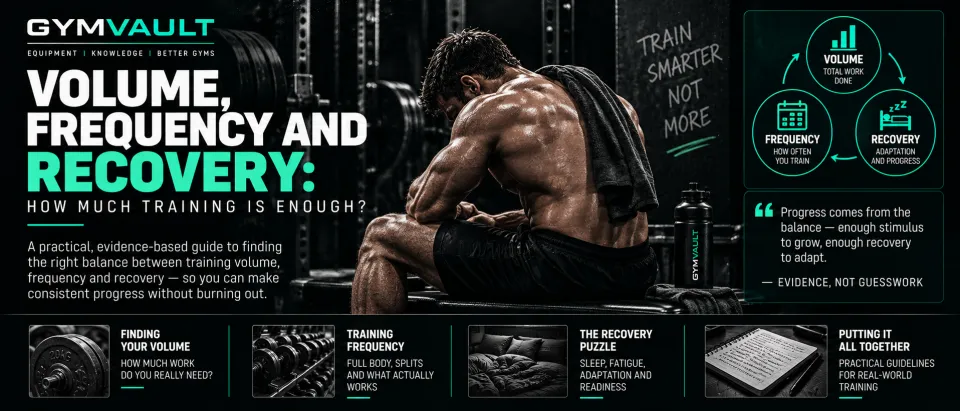
Most people who stop making progress are not doing the wrong exercises. They are doing the wrong amount, either too little to drive change or too much to recover from. This article looks at the three levers that set your training dose: volume, frequency and recovery.
Count sets per muscle per week
Researchers have settled on a simple way to count training volume: the number of hard sets each muscle receives in a week. A hard set is one taken reasonably close to failure. A set of ten easy repetitions with a light weight does not count.
There is a complication. A bench press trains the chest directly, but it also trains the triceps and front shoulders indirectly. A 2026 analysis of 67 studies tested different ways of counting these indirect sets. Results were best predicted when an indirect set counted as half a set for the muscle concerned (Pelland et al., 2026). That is a useful rule of thumb: count a row as one set for the back and half a set for the biceps.
How much volume builds muscle?
The evidence for a dose–response relationship between volume and muscle growth is now strong.
- A meta-regression of 15 studies found that more weekly sets produced more muscle growth in a graded way (Schoenfeld et al., 2017).
- In trained men who did one, three or five sets per exercise, three times a week for eight weeks, the higher-volume conditions produced more muscle growth at most of the sites measured (Schoenfeld et al., 2019).
- The 2026 meta-regressions confirmed that growth increases with volume but with diminishing returns (Pelland et al., 2026).
- The 2026 American College of Sports Medicine position stand concluded that muscle growth is enhanced by higher volumes of at least ten sets per week (Currier et al., 2026).
Does more keep helping indefinitely? Probably not. A review of trained young men found no difference in quadriceps or biceps growth between moderate volumes of 12–20 weekly sets and higher volumes above 20, although the triceps did respond to the higher volume (Baz-Valle et al., 2022). The authors suggested 12–20 weekly sets per muscle as a reasonable standard for young trained men.
It is also worth remembering that any sensible programme builds muscle compared with doing nothing. A network meta-analysis covering more than a hundred studies found that every prescription tested increased muscle size, and that the highest-ranked approach for growth combined multiple sets, heavier loads and two sessions a week (Currier et al., 2023).
How much volume builds strength?
Strength responds to volume too, but the curve flattens much sooner.
A meta-analysis of weekly set volume found a graded relationship with strength gain, with the lowest volumes producing the smallest improvements (Ralston et al., 2017). Yet in the eight-week trial mentioned above, one, three and five sets per exercise produced similar gains in squat and bench-press strength (Schoenfeld et al., 2019). The 2026 meta-regressions explain the apparent contradiction: diminishing returns set in much earlier for strength than for size (Pelland et al., 2026).
For people who mainly want to be stronger, or who have little time, that is good news. Relatively low volumes, performed with effort and heavier loads, go a long way.
Frequency: how to spread the work
Frequency is how many times a week a muscle is trained. Early research suggested that twice a week beat once a week for muscle growth when total volume was matched (Schoenfeld et al., 2016). A larger later analysis of 25 studies found no significant difference between frequencies on a volume-equated basis and concluded that people can choose based on preference (Schoenfeld, Grgic and Krieger, 2019).
Strength is different. Higher frequencies are associated with larger strength gains, but a meta-analysis of 22 studies found that the effect largely disappeared when volume was equal, suggesting that frequency helps strength mainly by allowing more total work (Grgic et al., 2018). The 2026 meta-regressions found a clearer independent benefit of frequency for strength, with diminishing returns, and little effect on muscle growth (Pelland et al., 2026). Practising a lift more often appears to make you better at it.
The practical takeaway is that frequency is a scheduling tool. Use it to fit your weekly volume into sessions of a length you can sustain. Twenty hard sets for the legs is gruelling in one session and quite manageable over two or three.
Recovery: the limit on everything else
Volume only helps if you can recover from it and repeat it. Several factors decide how much you can recover from.
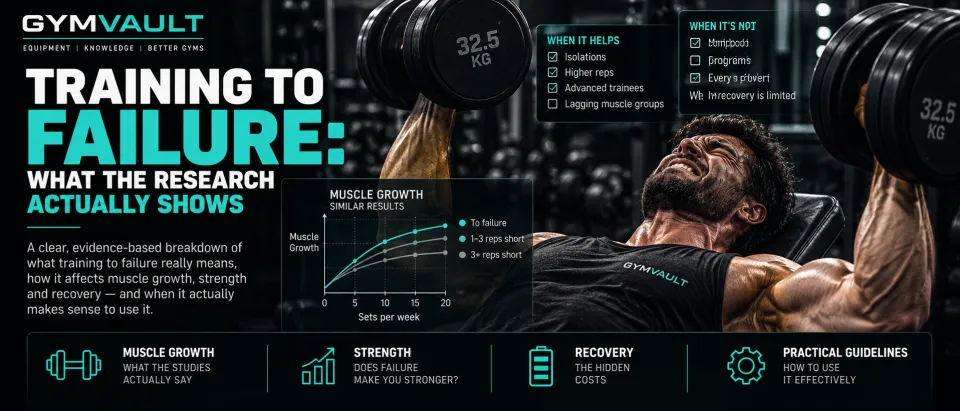
- How close sets go to failure. Sets taken to failure take longer to recover from, up to 24 to 48 hours for neuromuscular performance, than sets stopped at half the possible repetitions (Morán-Navarro et al., 2017).
- Rest between sets. In trained men, three-minute rests produced more strength and more thigh muscle growth than one-minute rests over eight weeks (Schoenfeld et al., 2016). Rushing between sets reduces how much quality work you can do.
- Life outside the gym. Sleep, nutrition, work stress and other physical activity all draw on the same capacity to recover.
There is also reassuring evidence for busy periods. After 16 weeks of training three times a week, young adults who cut their weekly dose to one third, or even one ninth, kept their muscle size over the following 32 weeks. Older adults needed a higher dose to keep their muscle size. Strength was largely retained across the board, even in a group that stopped training (Bickel et al., 2011). A short, hard maintenance week is far better than abandoning training altogether.
Building your week
These are starting points, not rules. Adjust them according to how you progress and how you feel.
| Situation | Sessions per week | Hard sets per muscle per week | Notes |
|---|---|---|---|
| New to training | 2–3 full-body | 6–10 | Learn the movements. Almost any sensible plan works. |
| Short on time | 2 full-body | 6–10 | One or two hard sets per exercise. Favour machines and compound lifts. |
| Building muscle | 3–4 (full-body or split) | 10–20 | Add sets gradually. Stop adding when recovery or progress suffers. |
| Building strength | 3–4 | Moderate | Heavier loads, two to four repetitions in reserve, frequent practice of key lifts. |
A practical approach is to start at the lower end, record every working set, and add one or two sets per muscle per week only when you are recovering well and progress has slowed.


What this means for a gym floor
Volume shapes equipment needs. Members who do several sets per exercise occupy a station for longer, so the machines everyone uses (chest press, lat pulldown, leg press, cable stations and the dumbbell rack) are the first to have queues. When you plan a floor, it is usually better to duplicate the most popular stations than to add a rarely used specialist machine. We cover this in Building a commercial gym on a defined budget.
References
- Baz-Valle E, Balsalobre-Fernández C, Alix-Fages C, Santos-Concejero J. A systematic review of the effects of different resistance training volumes on muscle hypertrophy. J Hum Kinet. 2022;81:199–210. doi:10.2478/hukin-2022-0017
- Bickel CS, Cross JM, Bamman MM. Exercise dosing to retain resistance training adaptations in young and older adults. Med Sci Sports Exerc. 2011;43(7):1177–1187. doi:10.1249/MSS.0b013e318207c15d
- Currier BS, Mcleod JC, Banfield L, et al. Resistance training prescription for muscle strength and hypertrophy in healthy adults: a systematic review and Bayesian network meta-analysis. Br J Sports Med. 2023;57(18):1211–1220. doi:10.1136/bjsports-2023-106807
- Currier BS, D'Souza AC, Singh MAF, et al. American College of Sports Medicine position stand. Resistance training prescription for muscle function, hypertrophy, and physical performance in healthy adults: an overview of reviews. Med Sci Sports Exerc. 2026;58(4):851–872. doi:10.1249/MSS.0000000000003897
- Grgic J, Schoenfeld BJ, Davies TB, et al. Effect of resistance training frequency on gains in muscular strength: a systematic review and meta-analysis. Sports Med. 2018;48(5):1207–1220. doi:10.1007/s40279-018-0872-x
- Morán-Navarro R, Pérez CE, Mora-Rodríguez R, et al. Time course of recovery following resistance training leading or not to failure. Eur J Appl Physiol. 2017;117(12):2387–2399. doi:10.1007/s00421-017-3725-7
- Pelland JC, Remmert JF, Robinson ZP, Hinson SR, Zourdos MC. The resistance training dose response: meta-regressions exploring the effects of weekly volume and frequency on muscle hypertrophy and strength gains. Sports Med. 2026;56(2):481–505. doi:10.1007/s40279-025-02344-w
- Ralston GW, Kilgore L, Wyatt FB, Baker JS. The effect of weekly set volume on strength gain: a meta-analysis. Sports Med. 2017;47(12):2585–2601. doi:10.1007/s40279-017-0762-7
- Schoenfeld BJ, Ogborn D, Krieger JW. Effects of resistance training frequency on measures of muscle hypertrophy: a systematic review and meta-analysis. Sports Med. 2016;46(11):1689–1697. doi:10.1007/s40279-016-0543-8
- Schoenfeld BJ, Pope ZK, Benik FM, et al. Longer interset rest periods enhance muscle strength and hypertrophy in resistance-trained men. J Strength Cond Res. 2016;30(7):1805–1812. doi:10.1519/JSC.0000000000001272
- Schoenfeld BJ, Ogborn D, Krieger JW. Dose–response relationship between weekly resistance training volume and increases in muscle mass: a systematic review and meta-analysis. J Sports Sci. 2017;35(11):1073–1082. doi:10.1080/02640414.2016.1210197
- Schoenfeld BJ, Contreras B, Krieger J, et al. Resistance training volume enhances muscle hypertrophy but not strength in trained men. Med Sci Sports Exerc. 2019;51(1):94–103. doi:10.1249/MSS.0000000000001764
- Schoenfeld BJ, Grgic J, Krieger J. How many times per week should a muscle be trained to maximize muscle hypertrophy? A systematic review and meta-analysis of studies examining the effects of resistance training frequency. J Sports Sci. 2019;37(11):1286–1295. doi:10.1080/02640414.2018.1555906
Further reading
- Mechanical tension and progressive overload, explained
- Dorian Yates and the case for fewer, harder sets
- Browse dumbbells and free weights
This article is general information about training and equipment. It is not medical advice. Speak to a qualified professional before starting a new exercise programme, particularly if you have an injury, a health condition or have been inactive.