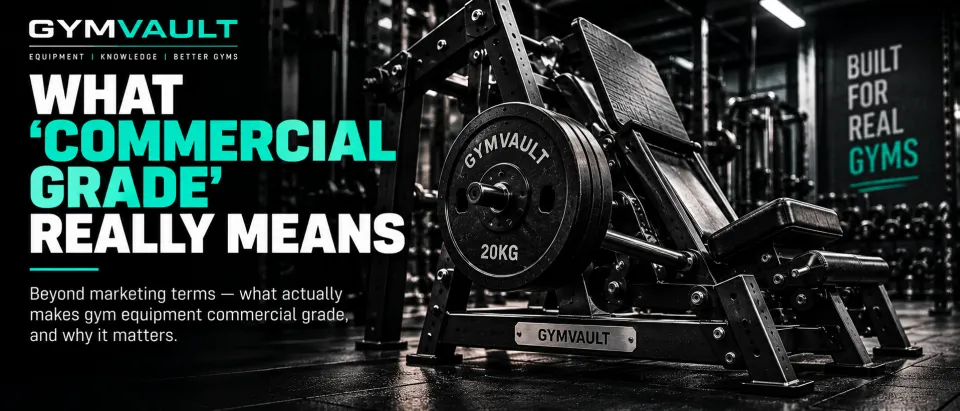
Search for gym equipment online and you will find the words "commercial grade" attached to almost anything. Sometimes it means a machine engineered for a busy club. Sometimes it means a home bench with thicker paint. Because the label is used so freely, buyers need a better way to judge it.
Is there an official definition?
There is no single legal definition of "commercial grade". The closest formal framework is the international standard for stationary training equipment, ISO 20957. Part 1, which sets general safety requirements and test methods, was most recently updated in 2024 and replaced the 2013 edition. It applies to indoor stationary training equipment and specifies a classification system (ISO, 2024):
- Classes S and I cover equipment for commercial and institutional training areas where access is regulated by the owner, such as clubs, hotels, schools, sports halls, rehabilitation centres and studios.
- Class H covers equipment for domestic use.
Further parts of the ISO 20957 series add requirements for particular types of equipment, and those take priority over the general part.
This gives you a useful first question to ask about any new or pre-owned machine: what class did the manufacturer design and test it for? Equipment built for the home is not designed for the workload of a shared facility, however solid it looks.
What actually differs
The classification is the headline. These are the differences you can see and feel.
Structure
Commercial machines are built around heavier steel sections, larger and more continuous welds, and wider, more stable bases. Plate-loaded commercial machines are designed to carry far more weight than most home equipment. The extra mass is a large part of why commercial frames outlast their wear parts many times over.
Wear parts designed to be replaced
Cables, belts, pulleys, bearings, bushings, grips and upholstery all wear with use. On commercial equipment they are designed to be inspected and replaced as routine maintenance, and manufacturers supply parts and service documentation. On a lot of home equipment, a worn part is the end of the machine's life.
Adjustability for many users
A club machine has to fit people of very different sizes, often with no instructor nearby. Commercial machines usually offer more seat, pad and range-of-motion adjustments, with clear markings so users can record their settings.
Safety features
Weight-stack shrouds, starting-position limiters, safety stops on leg presses and squat machines, and instruction placards are standard on commercial strength equipment, because it will be used unsupervised by people of every experience level.
Cardio motors and electrics
Commercial treadmills are designed for long daily running hours, with motors, decks and belts sized for that duty and electrical requirements to match. Before buying any commercial cardio machine, new or pre-owned, check its electrical specification against the supply where it will stand. In India that is 230 V at 50 Hz, and some commercial treadmills need a dedicated circuit.
Serviceability
This is the difference that matters most over a machine's life. Popular commercial lines have parts, service manuals and technicians who know them. A machine you cannot get parts for is only as good as its weakest component.


"Light commercial" and other grey areas
Between home and full commercial equipment sits a band of products marketed as "light commercial" or "semi-commercial". These labels have no standard meaning. They might describe equipment suitable for a small studio, a hotel or an apartment-block gym with modest use, or they might be marketing. Ask what class the product was designed and tested for, what the manufacturer's maximum user weight and load ratings are, and what the manufacturer's warranty says about commercial use.
Why commercial equipment suits the pre-owned market
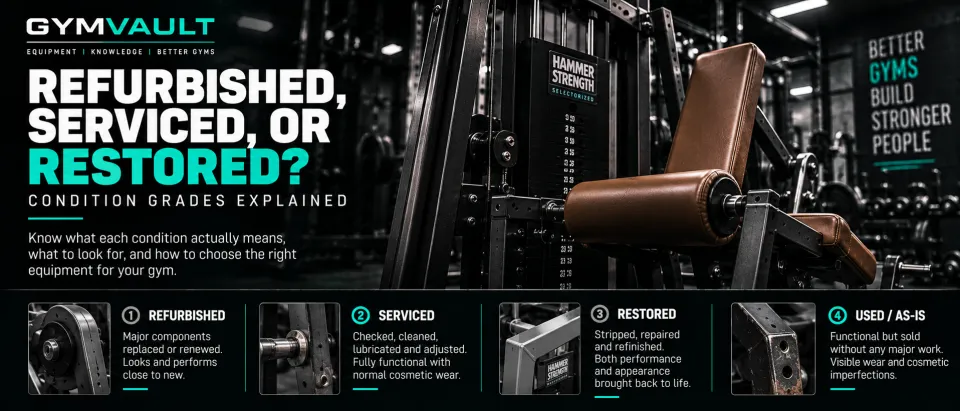
The features that make commercial equipment expensive new are the same features that make it a strong pre-owned buy. A sound frame, replaceable wear parts and good parts support mean that a well-maintained machine can be restored to excellent working order, and its value is not used up when its first owner refits. That is the basis of our business. We explain the economics in The economics of pre-owned commercial equipment.
How to choose equipment for a new gym
- Start with your users. A hotel gym used by guests who train alone needs simple, safe, self-explanatory machines. A coached studio can make more use of free weights and cables.
- Match equipment to supervision. The less supervision there is, the more the floor should lean towards selectorized machines with clear instructions and safety features.
- Prioritise serviceability. Choose lines that local technicians know and for which parts are available.
- Measure the space and the route. Check footprints and the clearance around each machine, and the doors, lifts, stairs and floor loading on the way in.
- Keep a consistent look. One or two equipment lines make a floor look intentional and help members learn the adjustments.
- Mix new and pre-owned deliberately. Pre-owned commercial equipment often gives the best value on robust strength machines. Buy new where you need a specific warranty, a particular finish, or equipment that is hard to find pre-owned.
- Plan electrics and flooring early. Cardio circuits and impact flooring for free-weight areas are much easier to install before the equipment arrives.
Questions to ask any seller
- Which brand, series and model is this, exactly?
- Was it designed for commercial use, and do you know its maximum user weight and load ratings?
- Which parts have been replaced, and are parts still available?
- What is included, and what is not?
- What are the delivery, installation and after-sales terms for this unit?
The ACSM's facility standards are a useful reference for the wider planning picture, including equipment, maintenance and facility design (ACSM, 2019). For a step-by-step approach to fitting out a facility, see Building a commercial gym on a defined budget.
References
- American College of Sports Medicine, Sanders M. ACSM's Health/Fitness Facility Standards and Guidelines. 5th ed. Human Kinetics; 2019. ISBN 9781492567189. humankinetics.com
- International Organization for Standardization. ISO 20957-1:2024 Stationary training equipment — Part 1: General safety requirements and test methods. Geneva: ISO; 2024. iso.org
Further reading
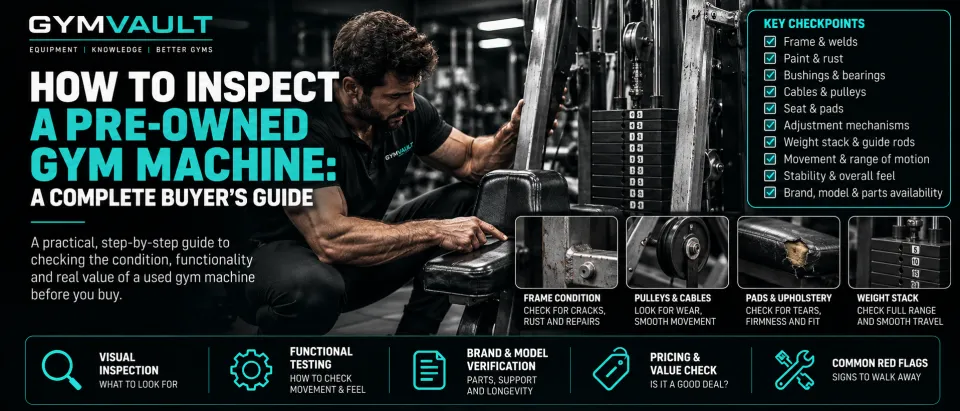
- How to inspect a pre-owned gym machine
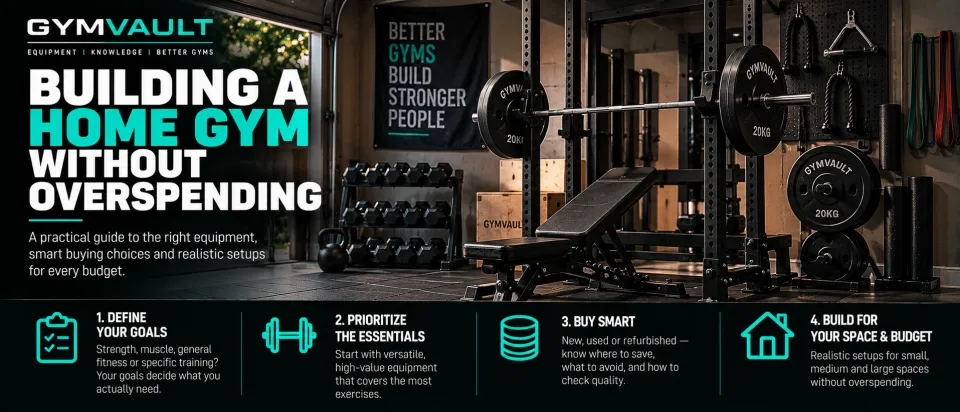
- Building a home gym without overspending
- Commercial solutions
This guide reflects GYMVAULT's own inspection practice. Always confirm the condition, specifications and terms of any specific machine before you buy it.