Every facility budget runs into the same tension. There is always another machine you could add, and never enough floor space, power or money for all of them. The facilities that feel best to train in are rarely the ones with the most equipment. They are the ones where the equipment matches the people using it.
This guide sets out a planning method that works for an independent gym, a hotel, a residential society or a corporate facility.
Step 1: Start with the members
Before you look at a single machine, answer four questions.
- Who will train here? Consider age range, experience, goals and whether members are mostly beginners, regulars or serious lifters.
- How closely will they be supervised? A staffed gym can support free weights and complex equipment. An unsupervised hotel or residential gym needs equipment that is safe and self-explanatory.
- When are the busy hours, and how many people train at once? Peak-hour numbers decide how many stations you need.
- What must the facility offer? The World Health Organization recommends that adults do regular aerobic activity and muscle-strengthening activity on two or more days a week (Bull et al., 2020). Most facilities should therefore support both cardio and whole-body strength training.
One finding makes the next decisions easier. The 2026 American College of Sports Medicine position stand found that equipment type did not consistently change training outcomes (Currier et al., 2026). That frees you to choose equipment for usability, safety, durability and throughput rather than prestige.
Step 2: Plan the floor in zones
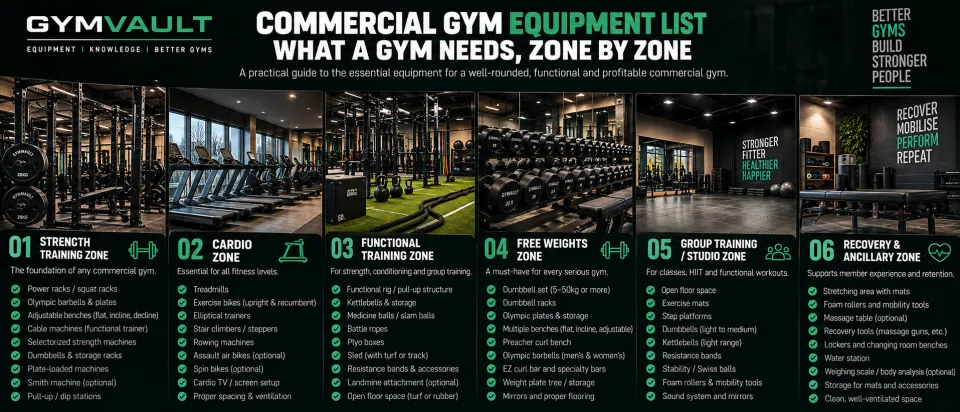
Divide the floor into zones before you choose equipment for them.
- Selectorized machine circuit. Simple, safe whole-body training for every member, and the backbone of unsupervised facilities.
- Plate-loaded machines and free weights. Heavier training for experienced members.
- Racks and benches. Squats, presses and barbell work, with safety arms.
- Cable and functional area. Versatile, space-efficient training for coached and independent members.
- Cardio. Placed where there is power, ventilation and, ideally, a view.
- Open space. Warm-ups, stretching, core work and coaching need floor area too.
For each zone, list the stations under three headings: must have, should have and nice to have. That list becomes your budget plan.
Step 3: Budget for what is not equipment
The most common budgeting mistake is spending the whole budget on machines. A facility also needs:
- Flooring, including impact flooring in free-weight areas;
- Electrics, including dedicated circuits for commercial treadmills, confirmed for a 230 V, 50 Hz supply in India;
- Ventilation or air conditioning, which also protects equipment from humidity and rust;
- Mirrors, storage and racks for plates, dumbbells and attachments;
- Signage and instructions, including safety placards on machines;
- Emergency planning, including first aid and, increasingly, an automated external defibrillator, which the ACSM's facility standards address (ACSM, 2019);
- Delivery and installation, including any lifting, stair work or partial disassembly for heavy machines.
Set this budget first and protect it. It is much harder and more expensive to add flooring or circuits once equipment is in place.
Step 4: Prioritise the stations that queue first
At peak hours, a few stations always queue: the chest press, lat pulldown and row, leg press, cable stations, benches, the dumbbell rack and the treadmills. Duplicating these usually does more for members than adding a specialist machine that a handful of people use.
When floor space is tight, multi-function selectorized stations and functional trainers can cover several movements in one footprint, which is why they suit hotels, residential gyms and corporate facilities.


Step 5: Spend where durability matters most
Not every item deserves the same treatment.
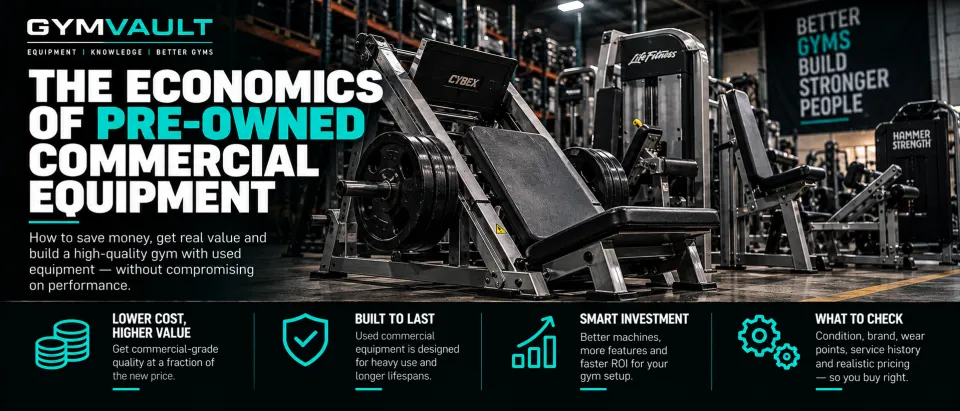
- Strength machines, racks and free weights are where pre-owned commercial equipment offers the strongest value. Their frames are built to last and their wear parts can be renewed. We explain why in The economics of pre-owned commercial equipment.
- Cardio equipment has motors and electronics, so look harder at its condition, its parts support and its after-sales terms. Buying new may suit you here if you need a specific warranty or the latest consoles.
- Anything members sit or lie on benefits from fresh upholstery, which is a relatively inexpensive way to make pre-owned equipment look and feel new.
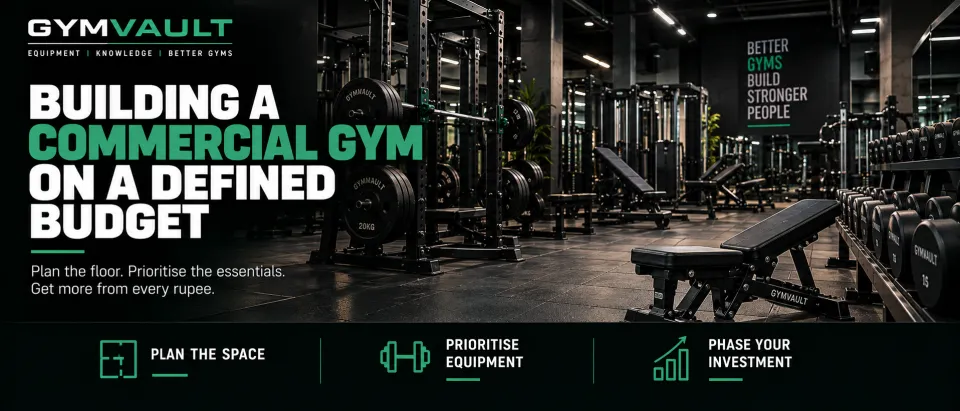
Step 6: Buy in phases
You do not need to buy everything on day one.
- Opening phase. Fit out the must-have stations in every zone, plus all the infrastructure.
- Review after a few months of use. Watch which stations queue and which sit empty. Your members will tell you what to buy next.
- Second phase. Add duplicates of the busiest stations and the should-have items your members actually want.
To make phasing work, leave floor space and electrical capacity in reserve for later additions. Planning flooring and circuits for the full floor at the start costs far less than retrofitting them.
Step 7: Plan the layout
- Leave clear walkways and enough space around every station to load it, adjust it and step away from it safely.
- Put cardio near power and ventilation, and free weights near mirrors on impact flooring.
- Arrange the machine circuit so members can move through it in a logical order.
- In staffed facilities, keep sightlines clear so staff can see the whole floor.
The ACSM's facility standards are a valuable reference for facility design, equipment, maintenance and emergency planning (ACSM, 2019).
Example starting points
These are illustrative starting lists, not prescriptions. The right list depends on your members, space and budget.
| Facility | A sensible opening floor |
|---|---|
| Hotel fitness room | Two or three cardio machines of different types, a functional trainer, an adjustable bench, a dumbbell set and rack, and two or three selectorized machines such as a chest press, lat pulldown and leg press |
| Residential society gym | Similar to a hotel, with more cardio for busy morning and evening hours, and an emphasis on simple, safe machines |
| Corporate facility | A compact selectorized circuit, a functional trainer, dumbbells and benches, and cardio sized to lunchtime and after-work peaks |
| Independent strength gym | Racks with safety arms, platforms, bars and plates, a full dumbbell run, benches, and heavy plate-loaded machines for legs, back and chest |
Step 8: One brief, one itemised quotation
The most efficient way to buy a floor is to describe the whole project once. A good supplier should be able to return a single itemised quotation that mixes units in stock with machines sourced for you, and that includes delivery, installation and after-sales terms for each unit.
That is how our commercial service works. Send us your brief, including members, space, budget and timeline, or build a quote list from the catalogue, and we will come back with an itemised proposal.
References
- American College of Sports Medicine, Sanders M. ACSM's Health/Fitness Facility Standards and Guidelines. 5th ed. Human Kinetics; 2019. ISBN 9781492567189. humankinetics.com
- Bull FC, Al-Ansari SS, Biddle S, et al. World Health Organization 2020 guidelines on physical activity and sedentary behaviour. Br J Sports Med. 2020;54(24):1451–1462. doi:10.1136/bjsports-2020-102955
- Currier BS, D'Souza AC, Singh MAF, et al. American College of Sports Medicine position stand. Resistance training prescription for muscle function, hypertrophy, and physical performance in healthy adults: an overview of reviews. Med Sci Sports Exerc. 2026;58(4):851–872. doi:10.1249/MSS.0000000000003897
Further reading
- The economics of pre-owned commercial equipment
- What "commercial grade" really means
- Free weights vs machines: what the evidence says
- Commercial solutions
This article is general information for planning purposes. It is not financial, tax or legal advice. Figures used in examples are illustrative, not quotes or market prices.