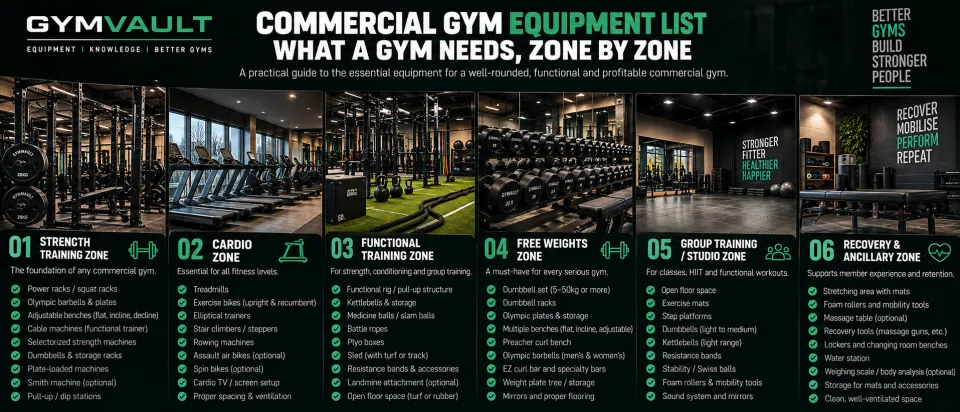
Most gym equipment lists are either a manufacturer's catalogue or a page of photographs with names under them. Neither tells you what a floor actually needs. This list is organised by zone. It explains what each piece of equipment is for and what to check before you buy it.
It is written for commercial and institutional facilities: independent gyms, hotels, housing-society and residential gyms, and corporate fitness rooms. For the planning and budgeting method behind it, read it alongside Building a commercial gym on a defined budget.
Start with movements, not machines
Before you choose a single machine, make sure your members will be able to train every major movement. Each row below can be covered by free weights, by machines, or by both.
| Movement | Free-weight option | Pin-loaded option | Plate-loaded option | Cable option |
|---|---|---|---|---|
| Horizontal push | Barbell or dumbbell bench press | Chest press | Iso-lateral bench or chest press | Cable press or crossover fly |
| Vertical push | Overhead press | Shoulder press | Iso-lateral shoulder press | Single-arm cable press |
| Vertical pull | Pull-up | Lat pulldown, assisted chin | Front pulldown | Cable pulldown |
| Horizontal pull | Dumbbell or barbell row | Seated row | Low row, T-bar row | Cable low row |
| Squat or leg press | Barbell squat | Leg press | Leg press, hack squat, pendulum or belt squat | None |
| Hip hinge | Deadlift, Romanian deadlift | Back extension | Hip thrust machine | Cable pull-through |
| Knee flexion and extension | Limited options | Leg curl, leg extension | Kneeling leg curl, leg extension | Ankle-strap curls and extensions |
| Arms | Dumbbells, EZ bar | Biceps and triceps machines | Seated biceps, seated dip | Cable curls and pushdowns |
| Core | Floor work, ab bench | Abdominal crunch | Abdominal crunch | Cable crunch |
Cover every row at least once before you add a second option to any of them. Then add duplicates of the stations that queue at peak hours.
1. Cardio
| Equipment | What it is for | What to check |
|---|---|---|
| Treadmill | Walking, running and incline walking | Belt and deck wear, drive noise, emergency stop, electrical supply |
| Elliptical cross-trainer | A gliding stride with no landing impact, with moving arm handles | Pivot and pedal bearings, noise through the stride, console |
| Upright and recumbent bikes | Seated cycling; recumbent bikes add a backrest | Seat adjustment, cranks and pedals, resistance |
| Indoor cycle | Studio and group cycling classes | Flywheel and brake, saddle and handlebar adjustment |
| Rowing machine | Seated, whole-body cardio | Chain or strap, seat rollers and rail |
| Stair climber | Climbing a moving staircase | Steps, drive, handrails |
| Air bike | Cycling against a fan, with moving arms | Fan housing, cranks, arm linkages |
| Ski ergometer | Standing, double-pole pulling | Cords, recoil, flywheel |
| Arc trainer | A gliding stride on an arc, a Cybex design | Linkages, pedals, console |
Two things are easy to overlook with cardio:
- Power. Commercial treadmills need serious electrical planning. Life Fitness's installation instructions for its Integrity treadmills specify a dedicated line for each commercial treadmill, and Cybex's 770T manual specifies a grounded, dedicated circuit (Life Fitness, 2022; Cybex, 2015). Check every model's voltage and frequency against your supply, which is 230 V, 50 Hz in India.
- Space. The same documents call for 2 m of clear space behind a treadmill, and Cybex adds 0.5 m on each side.
We cover what wears out on a treadmill, and how to check it, in Buying a used commercial treadmill.


2. Pin-loaded (selectorized) machines
Pin-loaded machines have a weight stack, a selector pin and a fixed path of movement. They are quick to learn and quick to adjust, and a set can end safely at any point without a spotter, which is why they form the backbone of most unsupervised floors.
| Body area | Machines |
|---|---|
| Chest and shoulders | Chest press, shoulder press, pec fly and rear deltoid |
| Back | Lat pulldown, seated row, pullover, assisted chin and dip |
| Legs | Leg press, leg extension, seated or lying leg curl, hip abduction and adduction, calf raise |
| Arms | Biceps curl, triceps extension or dip |
| Core | Abdominal crunch, back extension |
Where space is tight, dual-function machines combine two exercises in one footprint, such as a multi press, a lat pulldown with an arm station, or a pec fly that converts to a rear deltoid machine.
A selectorized chest press and a bench press do the same job for most members, as we explain in Chest press machine vs bench press.
What to check: cables or belts for fraying and cracking, pulleys and their bearings, smooth travel of the weight stack on its guide rods, the selector pin and stack holes, every seat and pad adjustment, the cam where there is one, and the upholstery. Our inspection guide goes through each step.

3. Plate-loaded machines
Plate-loaded machines carry Olympic plates on loading horns, on a lever arm or a sled. Many are iso-lateral, so each arm or leg moves independently. They suit experienced lifters, heavy loads and busy free-weight areas.
| Body area | Machines |
|---|---|
| Chest and shoulders | Iso-lateral bench, incline, decline and wide chest presses; shoulder press |
| Back | Front pulldown, high row, low row, T-bar row, pullover |
| Legs | 45-degree or linear leg press, iso-lateral leg press, hack squat, pendulum squat, belt squat, leg extension, kneeling leg curl, seated calf raise |
| Hips | Hip thrust machines |
| Arms | Seated biceps curl, seated dip |
Each plate-loaded machine needs plates and somewhere to store them, so plan a plate tree beside every one. Starting loads also differ a great deal from machine to machine, as we show in How much does a leg press weigh without plates?, and we compare the two big leg machines in Hack squat vs leg press.
What to check: the frame and welds, pivot bearings (or the sled's bearings and rails), the loading horns, safety stops and catches, and the upholstery. We compare the two machine types in Plate-loaded vs pin-loaded machines.


4. Cables and functional trainers
| Equipment | What it is for |
|---|---|
| Functional trainer (dual adjustable pulley) | Two independently adjustable pulleys for a very wide range of exercises; many include a pull-up bar |
| Cable crossover | A wide frame with two stacks for flys, crossovers and paired cable work |
| Single adjustable cable column | One adjustable pulley for small spaces |
| Lat pulldown and low row stations | Dedicated pulling stations, sometimes combined in one frame |
| Attachments | Straight and lat bars, V-bar, rope, single handles, ankle straps |
The number on a cable stack is not always the force at the handle, because many cable machines use pulley ratios. We explain how to compare them in Cable machine pulley ratios explained.
What to check: cables for fraying and kinks, pulleys that turn freely and quietly, the carriage adjustment pins, and the handles and attachments.
5. Racks, benches and Smith machines
| Equipment | What it is for | What to check |
|---|---|---|
| Power rack or half rack | Squats, presses and pulls, with safety arms | Welds, J-hooks, safety arms, fixing to the floor |
| Squat rack | Squats and presses in less space | Hooks, stability |
| Smith machine | Barbell training on a guided path | Bar travel, safety catches, counterbalance where fitted |
| Olympic flat, incline and decline benches | Barbell bench pressing with built-in uprights | Uprights, pads, stability |
| Adjustable bench | Dumbbell work at many angles | Adjustment mechanism, pins, upholstery |
| Arm curl (preacher) bench | Supported curls | Pad, seat adjustment |
| Back extension bench | Lower back, glutes and hamstrings | Pads, adjustment |
| Leg raise and dip station | Hanging leg raises, dips and core work | Pads, frame |
| Lifting platform | Deadlifts and Olympic lifts on a protected surface | Surface condition |
Smith machine bars are often lighter than a 20 kg Olympic bar, and the guided path changes the lift. We compare the two in Smith machine vs barbell squat.
6. Free weights
| Equipment | Notes |
|---|---|
| Dumbbells | A full run in fixed increments, in pairs, with round or hexagonal heads |
| Dumbbell racks | Two- or three-tier, sized to the run |
| Olympic barbells | The standard men's bar weighs 20 kg; lighter training bars suit beginners |
| EZ curl bars and fixed barbells | Arm work and quick sets |
| Weight plates | Iron or rubber-coated plates for machines and bars; bumper plates for platforms and lifts that are dropped |
| Plate trees and storage | One beside every rack and plate-loaded machine |
| Kettlebells | Swings, carries and conditioning |
| Collars | One pair for every barbell |
What to check: dumbbell heads that are tight with no rattle, handles and knurling, bars that are straight with sleeves that spin freely, and rubber that is not cracking or splitting.


7. Open floor space
Not every square metre should hold a machine. Warm-ups, stretching, core work, coaching and functional training need open space, usually with mats, plyometric boxes, medicine and slam balls, battle ropes, suspension trainers, resistance bands and, if there is room, a turf strip for sled work. These are smaller purchases, but the space for them has to be planned from the start.
8. What is not equipment
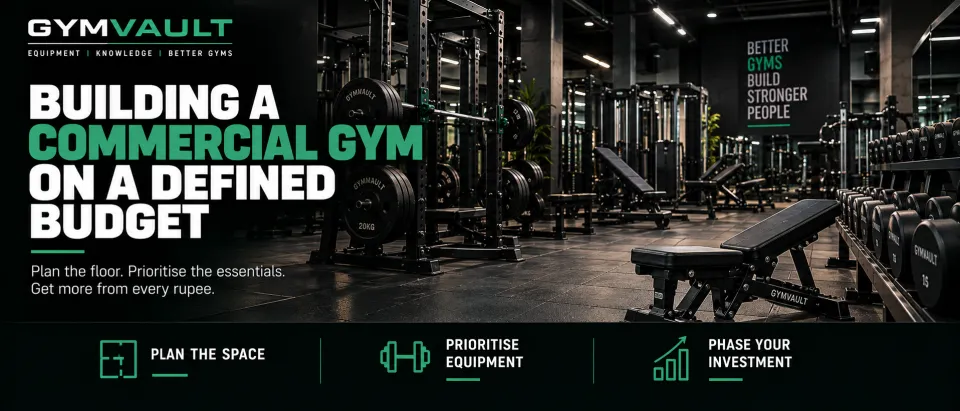
Flooring, electrics, ventilation or air conditioning, mirrors, storage, signage, first aid and emergency planning all compete for the same budget as the machines. The ACSM's facility standards are a useful reference for design, equipment, maintenance and emergency planning (ACSM, 2019). We list these items, and how to budget for them, in Building a commercial gym on a defined budget.
Commercial gym equipment brands
Brands you will meet on commercial floors include Hammer Strength, Life Fitness, Cybex, Technogym, Nautilus, Precor, Panatta, Matrix and Inflight Fitness for strength; Life Fitness, Technogym, Precor, Cybex, Matrix, StairMaster, Concept2, Assault Fitness and Keiser for cardio; and Eleiko, Rogue and Jordan for bars, plates and dumbbells. Our brands page introduces the brands in our catalogue. GYMVAULT is an independent reseller and is not affiliated with any of these manufacturers.
Whoever made it, ask for the manufacturer's model number and check it against the manufacturer's own catalogue or documentation, especially when a listing uses a well-known brand name loosely.
New or pre-owned?
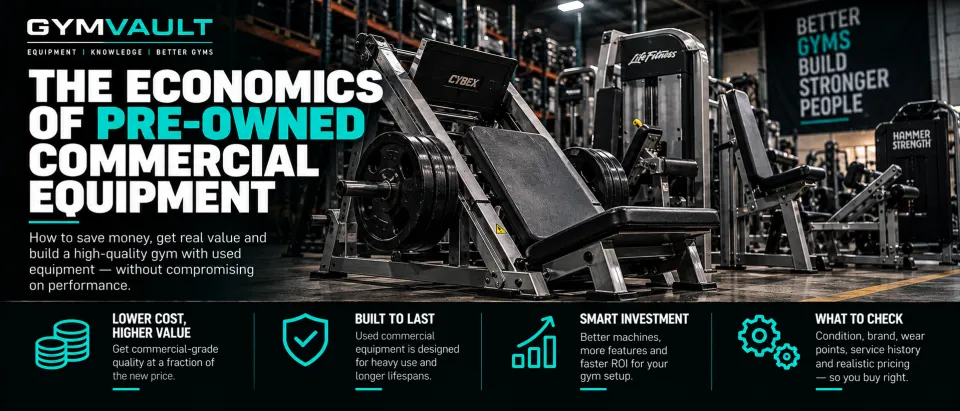
Pre-owned commercial equipment offers the strongest value on strength machines, racks and free weights, whose frames are built to last and whose wear parts can be renewed. Cardio machines have motors and electronics, so they deserve a closer look at their condition, parts support and after-sales terms. We explain the economics in The economics of pre-owned commercial equipment, and what condition grades mean in Refurbishment and condition grades explained.
Turning the list into a plan
- Start with your members and how closely they will be supervised.
- Cover the movement table above, with the type of equipment that suits them.
- Sort every item into must have, should have and nice to have.
- Duplicate the stations that queue first before adding specialist machines.
- Ask for one itemised quotation for the whole floor, including delivery, installation and after-sales terms for each unit.
That last step is how our commercial service works. Send us your brief, or build a quote list from the catalogue, and we will come back with an itemised proposal.
References
- American College of Sports Medicine, Sanders M. ACSM's Health/Fitness Facility Standards and Guidelines. 5th ed. Human Kinetics; 2019. ISBN 9781492567189. humankinetics.com
- Cybex. Cybex Treadmill Product Number 770T Owner's Manual. Part LT-22983-4 M. September 2015. kb.cybexintl.com
- Life Fitness. Integrity and Club Series+ Treadmill Assembly Instructions. 1015934-0001 Rev AD. 2022. kb.cybexintl.com
Further reading
- Building a commercial gym on a defined budget
- What "commercial grade" really means
- How to inspect a pre-owned gym machine
- Free weights vs machines: what the evidence says
- Browse all strength machines
- Commercial solutions
This article is general information for planning purposes. It is not financial, tax or legal advice. Figures used in examples are illustrative, not quotes or market prices.