Ask why muscles grow and you will hear many answers: the pump, the burn, soreness the next day, a surge of hormones, "confusing" the muscle. Most of them describe things that happen during or after training. Few of them describe what actually tells a muscle to grow. This article explains the current scientific view and turns it into a practical way of progressing.
What actually makes a muscle grow
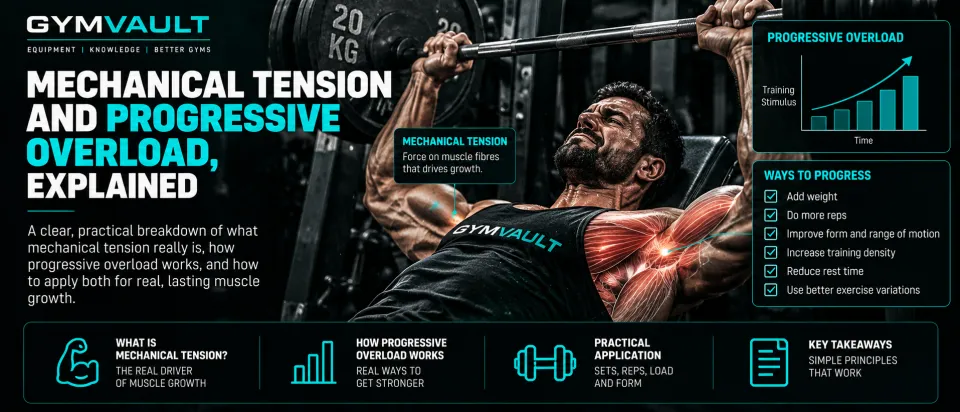
In an influential 2010 review, Brad Schoenfeld described three candidate drivers of exercise-induced muscle growth: mechanical tension, muscle damage and metabolic stress (Schoenfeld, 2010). Research since then has narrowed the field.
A 2019 review of the stimuli and sensors behind hypertrophy concluded that mechanical signals are the prime candidates. It found that muscle damage is probably not essential for growth, and that the case for metabolites as a stimulus rests on indirect evidence. The review also described how an increase in muscle protein synthesis, regulated through a signalling hub called mTORC1, is the key but not the only mechanism by which resistance exercise builds muscle (Wackerhage et al., 2019).
Two further studies help to clear away common myths.
- Soreness is not a measure of growth. When researchers tracked muscle protein synthesis across ten weeks of training, the large rise after the first sessions coincided with the most muscle damage and was not related to growth. Only from about the third week, once damage had faded, did protein synthesis track the muscle growth that followed (Damas et al., 2016).
- The post-workout hormone surge is not the cause. In 49 trained men, short-term rises in anabolic hormones after training were not related to gains in muscle or strength over 12 weeks (Morton et al., 2016).
The practical message is simple. What matters is the work the muscle fibres do against resistance, repeated over weeks and months, not how sore you feel or how pumped you look.
Tension without heavy weights
If tension is the signal, it is tempting to conclude that heavier is always better. The research is more interesting than that.
A 2017 meta-analysis compared low loads (60% of one-repetition maximum or less) with high loads (above 60%), including only studies in which every set was taken to momentary failure. Gains in one-repetition maximum strength were greater with heavy loads, but muscle growth was similar across the loading range (Schoenfeld et al., 2017). A 2021 network meta-analysis of 28 studies reached the same conclusion: muscle growth appeared to be independent of load when sets were taken to failure, while strength gains were greater with heavier loads (Lopez et al., 2021).
The same pattern held in trained lifters. Over 12 weeks, men lifting about 30–50% of their maximum for 20–25 repetitions and men lifting about 75–90% for 8–12 repetitions, all to failure, gained similar lean mass and muscle fibre size. Strength gains were similar for most lifts, with a larger bench-press gain in the heavier group (Morton et al., 2016).
Why should a light weight work? When a set continues close to failure, fatigue forces the muscle to call on more and more of its fibres to keep moving the load. By the final repetitions, a light set and a heavy set can both demand a great deal from the muscle. The light set simply takes longer to get there. This is why researchers have proposed retiring the old idea that particular repetition ranges are uniquely "for" strength, size or endurance, in favour of a wider view in which muscle can be built across many loading zones (Schoenfeld et al., 2021; Fisher et al., 2017).
There are practical limits. Very light sets are uncomfortable, take longer and make it harder to judge how close you are to failure. Heavy loads remain the most direct route to maximal strength, which is why the 2026 American College of Sports Medicine position stand found that voluntary strength was enhanced by loads of at least 80% of one-repetition maximum (Currier et al., 2026). For most people, a middle range of roughly 6 to 15 repetitions is a sensible default.
Progressive overload is more than adding weight
Muscles adapt to the demands placed on them. To keep adapting, the demand has to keep rising. That is progressive overload.
The classic guidance from the American College of Sports Medicine was to raise the load by about 2–10% once you can perform the current load for one or two repetitions more than your target (ACSM, 2009). Adding weight is not the only option, though. A 2022 trial assigned trained lifters either to increase load while keeping repetitions constant, or to increase repetitions while keeping load constant, for eight weeks of lower-body training. The two approaches produced similar results for muscle size, strength and endurance, with only small differences of questionable practical importance (Plotkin et al., 2022).
You can also progress by:
- Adding a set, when recovery allows and size is the goal.
- Improving control and range of motion, so the same load does more work.
- Resting longer between sets. In trained men, three-minute rest periods produced more strength and more thigh muscle growth than one-minute rests, probably because more work could be done in each set (Schoenfeld et al., 2016).
Why machines make progress measurable
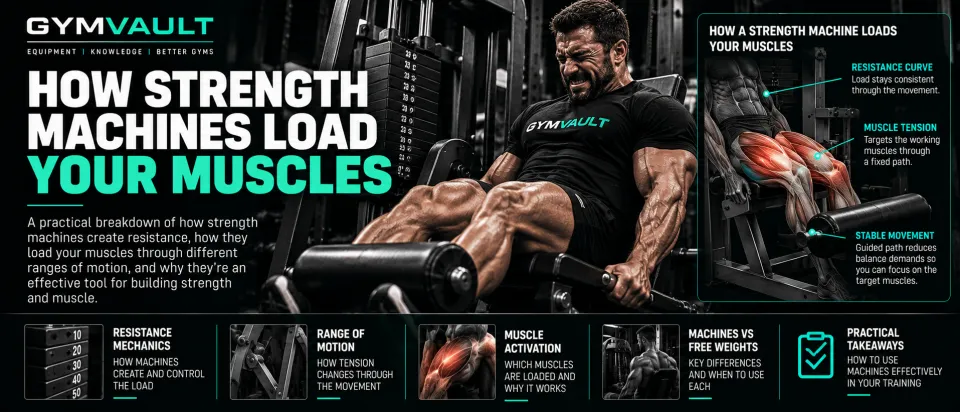
Progressive overload only works if you can tell whether you are progressing. Free weights do this well, because a kilogram is a kilogram. Machines can do it even better, provided you treat them consistently.
- Record the settings. Seat height, back-pad position and range-of-motion stops change the leverage of a machine. Write them down so every session starts from the same position.
- Use small increments. Plate-loaded machines accept small change plates. On selectorized machines, look for half-step or add-on weights where they are fitted.
- Compare like with like. A 50 kg setting on one brand of chest press is not the same as 50 kg on another. Track progress per machine, not per number.
- Keep the machine in good condition. Friction from a worn pulley, a dry guide rod or a frayed cable changes the resistance you feel. A machine that drifts in quality makes your records less reliable.


A simple progression model
The double progression method combines both routes to overload and needs nothing more than a notebook:
- Choose a repetition range for the exercise, for example 8 to 12.
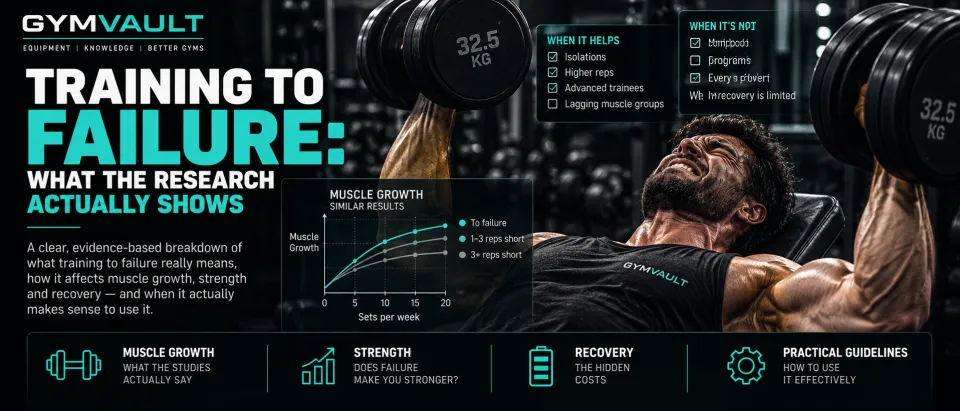
- Use a load that lets you complete the bottom of the range, finishing about one to three repetitions short of failure.
- Each session, try to add a repetition to one or more sets at the same load.
- When you reach the top of the range on all your working sets, increase the load by the smallest practical step and return to the bottom of the range.
- If progress stalls for several weeks, look at sleep, food and total weekly volume before changing exercises.
This is the same logic the research supports: keep the effort high, keep the muscle working against meaningful resistance, and keep the demand rising over time.
References
- American College of Sports Medicine. American College of Sports Medicine position stand. Progression models in resistance training for healthy adults. Med Sci Sports Exerc. 2009;41(3):687–708. doi:10.1249/MSS.0b013e3181915670
- Currier BS, D'Souza AC, Singh MAF, et al. American College of Sports Medicine position stand. Resistance training prescription for muscle function, hypertrophy, and physical performance in healthy adults: an overview of reviews. Med Sci Sports Exerc. 2026;58(4):851–872. doi:10.1249/MSS.0000000000003897
- Damas F, Phillips SM, Libardi CA, et al. Resistance training-induced changes in integrated myofibrillar protein synthesis are related to hypertrophy only after attenuation of muscle damage. J Physiol. 2016;594(18):5209–5222. doi:10.1113/JP272472
- Fisher J, Steele J, Smith D. High- and low-load resistance training: interpretation and practical application of current research findings. Sports Med. 2017;47(3):393–400. doi:10.1007/s40279-016-0602-1
- Lopez P, Radaelli R, Taaffe DR, et al. Resistance training load effects on muscle hypertrophy and strength gain: systematic review and network meta-analysis. Med Sci Sports Exerc. 2021;53(6):1206–1216. doi:10.1249/MSS.0000000000002585
- Morton RW, Oikawa SY, Wavell CG, et al. Neither load nor systemic hormones determine resistance training-mediated hypertrophy or strength gains in resistance-trained young men. J Appl Physiol. 2016;121(1):129–138. doi:10.1152/japplphysiol.00154.2016
- Plotkin D, Coleman M, Van Every D, et al. Progressive overload without progressing load? The effects of load or repetition progression on muscular adaptations. PeerJ. 2022;10:e14142. doi:10.7717/peerj.14142
- Schoenfeld BJ. The mechanisms of muscle hypertrophy and their application to resistance training. J Strength Cond Res. 2010;24(10):2857–2872. doi:10.1519/JSC.0b013e3181e840f3
- Schoenfeld BJ, Pope ZK, Benik FM, et al. Longer interset rest periods enhance muscle strength and hypertrophy in resistance-trained men. J Strength Cond Res. 2016;30(7):1805–1812. doi:10.1519/JSC.0000000000001272
- Schoenfeld BJ, Grgic J, Ogborn D, Krieger JW. Strength and hypertrophy adaptations between low- vs. high-load resistance training: a systematic review and meta-analysis. J Strength Cond Res. 2017;31(12):3508–3523. doi:10.1519/JSC.0000000000002200
- Schoenfeld BJ, Grgic J, Van Every DW, Plotkin DL. Loading recommendations for muscle strength, hypertrophy, and local endurance: a re-examination of the repetition continuum. Sports (Basel). 2021;9(2):32. doi:10.3390/sports9020032
- Wackerhage H, Schoenfeld BJ, Hamilton DL, Lehti M, Hulmi JJ. Stimuli and sensors that initiate skeletal muscle hypertrophy following resistance exercise. J Appl Physiol. 2019;126(1):30–43. doi:10.1152/japplphysiol.00685.2018
Further reading
- Training to failure: what the research actually shows
- Volume, frequency and recovery: how much training is enough?
- Browse selectorized machines
This article is general information about training and equipment. It is not medical advice. Speak to a qualified professional before starting a new exercise programme, particularly if you have an injury, a health condition or have been inactive.