Anyone who has trained in more than one gym has noticed it. Forty kilograms on one chest press feels like sixty on another. A leg curl that felt smooth last week now catches halfway up. The weight did not change. The leverage did.
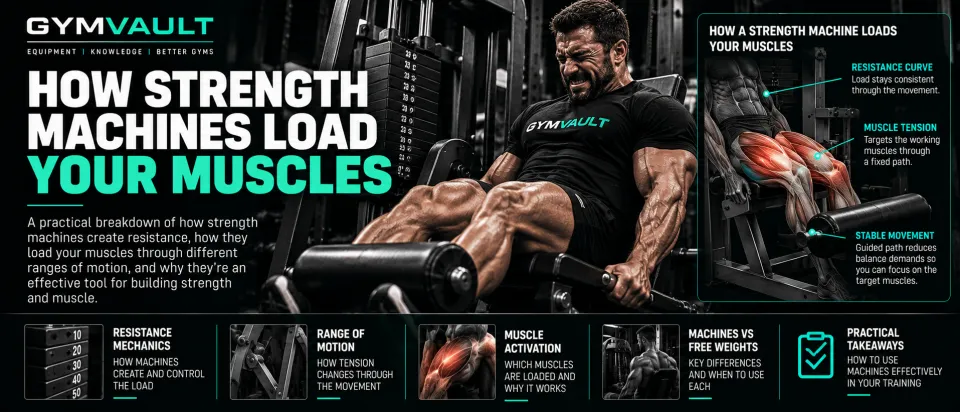
This article explains the basic mechanics behind strength machines in plain language. It will help you set machines up properly, understand why some feel better than others, and judge machines more critically when you buy them.
Torque, not kilograms
Muscles rotate joints. What a muscle has to overcome is not the weight itself but the turning effect of that weight around the joint, called torque. Torque equals force multiplied by the perpendicular distance between the line of that force and the joint. That distance is called the moment arm.
A dumbbell lateral raise shows the idea clearly. At the bottom, with your arm hanging, the dumbbell's weight acts almost straight through your shoulder. The moment arm is close to zero and the raise feels easy. With your arm horizontal, the moment arm is at its longest and the same dumbbell feels heaviest. The weight has not changed at all. Its leverage has.
Your muscles have leverage problems of their own. The force a muscle can produce changes with its length, and its own moment arm around the joint changes with joint angle. The result is that the force you can exert varies through a movement, a pattern known as a strength curve (Kulig et al., 1984). Strength curves are commonly described as ascending, descending, or ascending and then descending through the range of motion.
A machine's job is to decide how the resistance should change through the movement. Here are the main ways it does that.
Four ways machines shape resistance
1. Cables and round pulleys
A cable running over round pulleys transmits the weight of the stack along the cable, but the torque at your joint still depends on the angle between the cable and your limb. That is why the height of a cable pulley changes an exercise so much. A triceps extension from a low pulley, a high pulley or overhead loads the elbow very differently through the range. Adjustable cable columns and functional trainers give you control over this angle.
2. Cams
A cam is a pulley with a changing radius. As it turns, the moment arm of the cable around the cam's axle changes, so the resistance at the user's joint rises and falls on a profile set by the cam's shape. In principle a cam can match the resistance to a strength curve. In practice, measurements of eight cam-based knee extension machines from six manufacturers found profiles that were highly variable and consistently flatter than the muscles' actual strength curve (Folland and Morris, 2008). We look at this in Resistance curves and why the cam matters.
3. Plate-loaded levers
On a plate-loaded lever machine, the plates sit on horns attached to a lever arm that rotates around a pivot. The resistance depends on the horizontal distance between the plates' centre of mass and the pivot, and that distance changes as the lever moves. Designers shape the resistance curve by choosing where the pivot sits, where the load horns sit, and the angle of the lever at the start of the movement. Moving the same plates to a different horn on the same machine can change how heavy it feels and where it feels hardest.
Many plate-loaded designs also use independent arms, with each side on its own lever. Hammer Strength's Iso-Lateral machines are a well-known example. Each arm or leg can follow its own path and do its own share of the work, which makes side-to-side differences obvious.
4. Guided movement arms
Most selectorized machines connect the stack to a movement arm that rotates around a fixed pivot or follows a set path. The arm decides the direction the handles travel. Converging chest presses, for example, bring the handles together as you press, which many people find more natural than a perfectly straight path.
Alignment: why seat settings matter
On a single-joint machine such as a leg extension, leg curl or arm curl, the machine's pivot should line up with your joint. Your knee should sit in line with the axis of the leg extension's movement arm, and your elbow should sit in line with the axis of an arm curl.
When the two axes do not line up, the pad slides along your shin or forearm as you move. That shifts the moment arm, changes the resistance curve the designer intended, and can make the movement uncomfortable. Small adjustments to the seat height or back pad usually fix it.
On multi-joint machines such as chest presses, rows and leg presses, the seat position decides where the handles meet your body, how much stretch you start from, and how much range you get. A good rule is to set the machine so the handles or footplate start in a position where you feel a stretch but can still control the load, and then to record that setting.
Training at long muscle lengths
One of the most interesting research areas of the past five years concerns the position in which a muscle is loaded. Several studies suggest that muscles grow more when they are trained hard while lengthened.
- Hamstrings. Over 12 weeks, seated leg curls, which train the hamstrings with the hips bent and the muscle lengthened, increased whole-hamstring volume by 14%, compared with 9% for lying leg curls in the other leg of the same people (Maeo et al., 2021).
- Triceps. Cable elbow extensions with the arm overhead, which lengthens the long head of the triceps, produced about 1.4 times the growth of the whole triceps compared with the same exercise with the arm at the side, despite lighter loads (Maeo et al., 2023).
- Quadriceps. In untrained women, knee extensions performed only through the more bent part of the range produced greater relative growth in some regions of the quadriceps than full-range or short-range training (Pedrosa et al., 2022).
- Calves. In young women, calf raises in the stretched part of the range, performed on a pin-loaded leg-press machine, produced more growth of the inner (medial) calf muscle than full-range or short-range calf raises (Kassiano et al., 2023).
- Biceps. Preacher curls, which load the elbow flexors most heavily when they are lengthened, increased muscle thickness near the elbow over nine weeks, while incline curls produced no measurable growth at the sites measured. The difference between the two groups, however, was not statistically significant (Zabaleta-Korta et al., 2023).
Two cautions apply. This is a young area of research, and most studies are short and involve untrained or recreationally trained people. And full range of motion is still a very good default. A systematic review found that full-range training benefits lower-body muscle growth compared with partial ranges (Schoenfeld and Grgic, 2020), and a later meta-analysis found a small overall advantage for full range, with a possible extra benefit for partial training at long muscle lengths (Wolf et al., 2023).


What this means when you choose machines
- Prefer machines that load the stretched position well. Seated leg curls, pullovers, preacher-style curls, deep hack squats and pendulum squats, and cable stations that allow overhead triceps work all do this.
- Check the adjustments. A machine that cannot be adjusted to align with your joints, or that cannot set a comfortable starting range, will be a poor fit for many members.
- Feel the curve. Move the machine slowly through its full range with a moderate load. Note where it feels hardest and whether it feels smooth. Sticking points that come and go with the load can be a design feature. A catch or grind that appears at the same point every time usually points to wear.
- Remember that condition changes mechanics. Worn pivot bearings, dry guide rods and stretched cables add friction and change the feel of a machine long before anything breaks. That is why we test every machine through its full range under load as part of our inspection process.
References
- Folland J, Morris B. Variable-cam resistance training machines: do they match the angle–torque relationship in humans? J Sports Sci. 2008;26(2):163–169. doi:10.1080/02640410701370663
- Kassiano W, Costa B, Kunevaliki G, et al. Greater gastrocnemius muscle hypertrophy after partial range of motion training performed at long muscle lengths. J Strength Cond Res. 2023;37(9):1746–1753. doi:10.1519/JSC.0000000000004460
- Kulig K, Andrews JG, Hay JG. Human strength curves. Exerc Sport Sci Rev. 1984;12:417–466. PubMed 6376139
- Maeo S, Huang M, Wu Y, et al. Greater hamstrings muscle hypertrophy but similar damage protection after training at long versus short muscle lengths. Med Sci Sports Exerc. 2021;53(4):825–837. doi:10.1249/MSS.0000000000002523
- Maeo S, Wu Y, Huang M, et al. Triceps brachii hypertrophy is substantially greater after elbow extension training performed in the overhead versus neutral arm position. Eur J Sport Sci. 2023;23(7):1240–1250. doi:10.1080/17461391.2022.2100279
- Pedrosa GF, Lima FV, Schoenfeld BJ, et al. Partial range of motion training elicits favorable improvements in muscular adaptations when carried out at long muscle lengths. Eur J Sport Sci. 2022;22(8):1250–1260. doi:10.1080/17461391.2021.1927199
- Schoenfeld BJ, Grgic J. Effects of range of motion on muscle development during resistance training interventions: a systematic review. SAGE Open Med. 2020;8:2050312120901559. doi:10.1177/2050312120901559
- Wolf M, Androulakis-Korakakis P, Fisher J, Schoenfeld B, Steele J. Partial vs full range of motion resistance training: a systematic review and meta-analysis. Int J Strength Cond. 2023;3(1). doi:10.47206/ijsc.v3i1.182
- Zabaleta-Korta A, Fernández-Peña E, Torres-Unda J, et al. Regional hypertrophy: the effect of exercises at long and short muscle lengths in recreationally trained women. J Hum Kinet. 2023;87:259–270. doi:10.5114/jhk/163561
Further reading
- Resistance curves and why the cam matters
- Free weights vs machines: what the evidence says
- Browse leg machines
This article is general information about training and equipment. It is not medical advice. Speak to a qualified professional before starting a new exercise programme, particularly if you have an injury, a health condition or have been inactive.