Treadmills are where pre-owned buying needs the most care. A strength machine is mostly steel, with a few wear parts that are easy to see. A treadmill has a motor, a motor controller, a lift system, electronics and a belt that rubs over a deck every time someone takes a step. The good news is that commercial treadmills are designed to be serviced, and their manufacturers publish exactly what wears and how to check it.
Commercial and home treadmills are built differently
Life Fitness, for example, lists the designed use of its commercial Integrity treadmills as "Heavy / Commercial EN ISO 20957 Class S", and of its home models as Class H (Life Fitness, 2022). Commercial treadmills are built for long daily use and for servicing, with wear parts that can be replaced. That is what makes them worth buying pre-owned, provided you check them properly. We explain the classification in What "commercial grade" really means.
The treadmill-specific safety standard is ISO 20957-6, now in its 2021 edition, which is applied together with the general requirements of ISO 20957-1. ISO notes that the 2021 edition does not apply to treadmills manufactured before its publication (ISO, 2021), so an older pre-owned treadmill will have been built to an earlier edition.
What wears out
Running belt and deck
The belt and the deck it runs over are the main wear items, and manufacturers schedule them by distance:
| Interval | Cybex 770T service schedule |
|---|---|
| First 500 miles (800 km) | Check running belt tension and tracking |
| Every 5,000 miles (8,000 km) | Check tension and tracking; vacuum the motor controller's fan and heat sink area |
| Every 15,000 miles (24,140 km) | Replace the running belt and flip the deck |
| Every 30,000 miles (48,280 km) | Replace the running belt and deck |
Source: Cybex 770T owner's manual (Cybex, 2015).
Signs that a belt and deck are worn, from the manufacturers' documents:
- Glazing. Life Fitness says to replace the belt and deck when "the deck laminate is worn through or the underside of striding belt is glazed over" (Life Fitness, 2022).
- A worn logo. Star Trac's service manual asks technicians to confirm that the running belt's logo "is not 75% worn out" (Star Trac, 2017).
- Tears, fraying and high current. Life Fitness advises that a Cybex running belt that "is found to be worn or drawing high amps" should be replaced (Life Fitness, 2022b). A worn belt and deck create more friction, which makes the motor work harder.
Many commercial decks are reversible. Life Fitness, Star Trac and Cybex all describe decks that can be flipped, which gives a deck a second life when the belt is replaced. Lubrication differs by brand and era: some belts are wax-lubricated and others are lubricant-infused, while Star Trac describes its decks as "waxing not required". Follow the manufacturer's instructions, never a general-purpose lubricant.
Drive system and electronics
Precor's preventative maintenance schedule includes monthly cleaning of the drive belt and pulley and inspection of the running belt and deck with "amp readings per Service Manual", and quarterly checks of drive belt tension and vacuuming of the motor compartment and controller fan (Precor, n.d.). Dust and heat are the enemies of motor controllers, so a treadmill that has been cleaned inside is a good sign.
Rollers, lift system and safety stop
- Rollers. Life Fitness's maintenance checklist includes inspecting the front and rear rollers. Star Trac's manual says not to lubricate the roller bearings.
- Incline. Precor lists lubricating the lift motor screw every six or twelve months.
- Emergency stop. Life Fitness says to check the emergency stop system once a week.
Motor ratings: compare like with like
Treadmill motors are described in horsepower, but not always on the same basis. Life Fitness describes one Integrity motor as "4-HP AC Continuous Duty (8-HP Peak Duty)" (Life Fitness, 2022), so the same motor could be quoted as 4 HP or 8 HP. Other brochures give a single figure with no basis at all. When you compare treadmills, ask whether a horsepower figure is continuous or peak, and do not compare one with the other.
Electrics and space
Power. Commercial treadmills need serious electrical planning:
- Life Fitness specifies a dedicated line with isolated neutral, with one individual branch circuit for each commercial treadmill, and lists versions for 200 to 240 V at 50/60 Hz (Life Fitness, 2022).
- Cybex specifies "a grounded, dedicated circuit", including a "230 VAC, 50 Hz, 13A" version (Cybex, 2015).
- Star Trac "requires a 20 amp dedicated circuit and dedicated neutral for each treadmill" (Star Trac, 2017).
India's supply is 230 V, 50 Hz, so check the voltage and frequency on the machine's label, and make sure your site has a dedicated circuit for every treadmill before it arrives. Life Fitness also warns that the product "must be properly grounded" and not to modify the plug. One detail matters for imported units: on Precor's 700 Line, a pulsing blue status light indicates that the belt needs replacing, "except for 230 V models" (Precor, 2016), so on those models you cannot rely on that light.
Space. Life Fitness cites the EN ISO 20957 safety standard as requiring 2 m of clear space behind a treadmill, and Cybex specifies 2 m behind and 0.5 m on each side (Life Fitness, 2022; Cybex, 2015). Plan this before you choose where the treadmill goes.
The in-person checklist
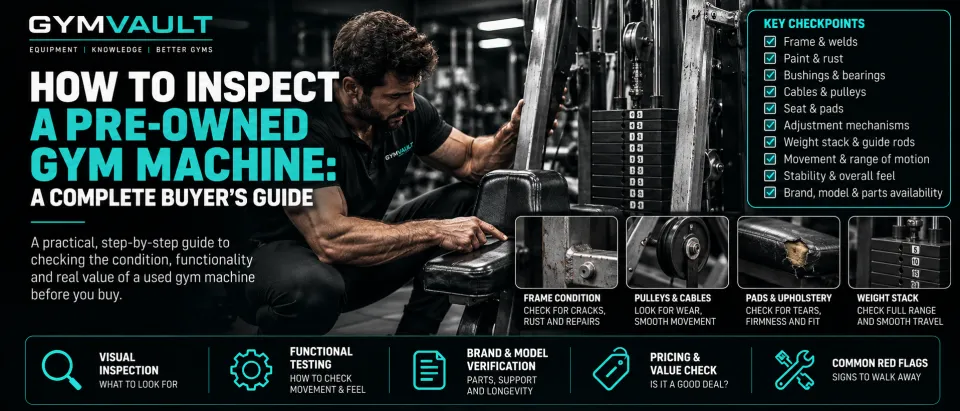
- Look before you switch it on. Check the frame and welds, the deck edges, the side rails and handrails, and the console. Lift the belt edge if you can and look at its underside: it should not be hard and glossy.
- Check the label. Note the model, serial number, voltage and frequency.
- Test the emergency stop. At a walking speed, pull the safety clip or press the stop. The belt should stop and should not restart until the stop is reset.
- Walk, then run. Use several speeds and the full incline range. Listen for grinding, knocking or squealing, and feel for hesitation, surging or slipping. Life Fitness's own tension check is to walk at 3.2 km/h: if the belt does not slip, the tension is correct.
- Watch the tracking. The belt should run centred and stay centred. Some models have tracking indicators on the rear roller guards.
- Test the console. Check every button, display, program and safety message. Note any error codes.
- Ask about the inside. Has the motor compartment been opened, cleaned and checked? When were the belt, deck and drive belt last replaced?
Questions to ask the seller
- What are the make, model, serial number and year of manufacture?
- What is the total distance or running time recorded? Many commercial treadmills track this. Matrix's MX-T3x, for example, lights a maintenance lamp when its accumulated distance reaches 5,000 miles.
- Where was it used, and how heavily?
- When were the belt, deck and drive belt replaced, and is there a service record?
- Are there any faults or error codes?
- What voltage, frequency and plug does it use?
- What is included: safety clip, power cord, manuals?
- Who can supply parts and service it where you are?
- What are the delivery, installation, warranty and return terms, in writing?
When buying used makes sense
A pre-owned commercial treadmill makes the most sense when you can confirm its condition, when its voltage suits your site, and when parts and service are available locally. If you need a specific warranty or the latest console features, a new machine may suit you better. For strength equipment the case for pre-owned is stronger still, as we explain in The economics of pre-owned commercial equipment. For the rest of a cardio zone, see our commercial gym equipment list.

The bottom line
Judge a used commercial treadmill by its belt and deck, its drive and electronics, its safety stop and its paperwork, not by its paint. Confirm the electrical specification against your supply, plan a dedicated circuit and the clear space it needs, and get the condition and terms in writing. Our general inspection guide covers the rest of the gym floor.
References
- Cybex. Cybex Treadmill Product Number 770T Owner's Manual. Part LT-22983-4 M. September 2015. kb.cybexintl.com
- International Organization for Standardization. ISO 20957-6:2021, Stationary training equipment, Part 6: Treadmills, additional specific safety requirements and test methods. iso.org
- Life Fitness. Integrity and Club Series+ Treadmill Assembly Instructions. 1015934-0001 Rev AD. 2022. kb.cybexintl.com
- Life Fitness. Cybex 525T, 625T, 770T, 790T treadmill running belt details. Support article, updated 28 February 2022. support.lifefitness.com
- Life Fitness. The importance of preventive maintenance. Service agreement brochure. lifefitness.com
- Matrix Fitness. MX-T3x Series Treadmill Owner's Manual (copy hosted by a retailer). cdn.shopify.com
- Precor. Preventative maintenance. precor.com
- Precor. 700 Line Treadmill Getting Started Guide. P/N 304388-101 rev A. August 2016. static.precor.com
- Star Trac. Treadmill Technical Manual. P/N 637-4504 Rev. B, updated 6 March 2017 (copy hosted by Sportsmith). assets.sportsmith.com
Further reading
- How to inspect a pre-owned gym machine
- Refurbishment and condition grades explained
- What "commercial grade" really means
- Browse cardio equipment
This guide reflects GYMVAULT's own inspection practice. Always confirm the condition, specifications and terms of any specific machine before you buy it.