Pick up a dumbbell and curl it slowly. Near the bottom the weight feels light. Around the middle, with your forearm horizontal, it feels heaviest. Near the top it becomes easy again. Your arm did not change strength suddenly. The leverage of the dumbbell changed.
That simple observation sits behind a century of equipment design, the most famous example of which is the Nautilus cam. This article explains the idea, what research says about how well machines achieve it, and why it matters less, and in different ways, than the marketing once claimed.
Two curves that rarely agree
It helps to keep two ideas separate.
- The resistance curve of an exercise describes how much torque the load demands at each point of the movement.
- The strength curve of a muscle group describes how much torque you can produce at each point. It changes with joint angle because both muscle length and the muscle's own leverage change (Kulig et al., 1984).
When the two curves have different shapes, part of the range limits the whole set. In a dumbbell curl, the middle of the movement decides how much you can lift, and the bottom and top are under-loaded. In a lateral raise, the top limits you and the bottom barely loads the shoulder at all.
Three ways to reshape the resistance curve
Cams
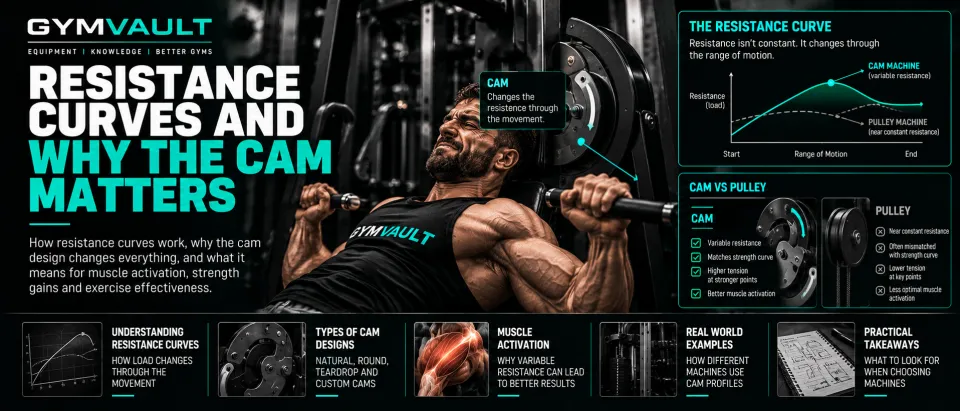
A cam is a pulley whose radius changes as it turns. Where the radius is longer, the stack has more leverage against you and the movement feels heavier. Where it is shorter, the movement feels lighter. By choosing the cam's profile, a designer chooses the resistance curve.
Arthur Jones built his Nautilus machines around this idea from 1970 onwards, and the spiral cam gave the brand its name. We tell that story in Arthur Jones, Nautilus and the birth of high-intensity training.
Levers
Plate-loaded machines usually have no cam. Instead, the plates sit on a lever arm that rotates around a pivot. As the lever moves, the horizontal distance between the plates and the pivot changes, so the resistance changes too. The designer shapes the curve through the position of the pivot, the position of the loading horns, and the starting angle of the lever.
Bands and chains
On free weights, elastic bands and heavy chains add resistance as the bar rises, because the band stretches or more chain links lift off the floor. This is the same principle in portable form: make the strong part of a lift heavier.
How well do machines match human strength?
This is a measurable question, and it has been measured.
When researchers at Loughborough University assessed eight cam-based knee extension machines from six manufacturers, they compared each machine's resistance profile with the real strength of ten young men at the same knee angles. The men's knee extension strength followed an inverted U shape, rising by about 40% and then falling by about 60% across the range tested. The machines were highly variable and consistently less curved. Their resistance changed by only +2.5% to +22% over the first part of the range, and by anything from +38% to −21% over the second (Folland and Morris, 2008). The authors recommended that cams be designed with the specific joint's strength curve in mind.
An earlier analysis of the Nautilus leg curl reached a similar conclusion for the hamstrings. The machine's resistance torque pattern was not similar to the torque pattern of the knee flexors, and the authors concluded that it did not alter the load in a way suited to their capabilities (Pizzimenti, 1992).
So cams change the resistance curve, but they rarely match a muscle's strength curve closely, and different machines for the same exercise can feel very different.
Does a perfect match matter?
Here the honest answer is that we do not know that it does. The idea that a matched curve produces better results is intuitive, but it has not been shown in long-term training studies.
When researchers compared eight weeks of training on free weights with training on machines, describing machines with cams as better matched to strength curves, the two groups gained similar muscle thickness and similar strength on most tests. The machine group did gain more on the machine bench press, which is what you would expect from practising that test (Schwanbeck et al., 2020). The 2026 American College of Sports Medicine position stand, an overview of 137 systematic reviews, found that equipment type did not consistently affect training outcomes (Currier et al., 2026).
What does seem to matter is where the resistance is highest. Several recent studies suggest that loading a muscle hard in its lengthened position produces more growth. Seated leg curls, which keep the hamstrings lengthened, grew the hamstrings more than lying leg curls (Maeo et al., 2021). Overhead triceps extensions grew the triceps more than the same exercise with the arm at the side (Maeo et al., 2023). Preacher curls, whose resistance peaks when the elbow flexors are stretched, increased muscle thickness near the elbow, although the difference from incline curls was not statistically significant (Zabaleta-Korta et al., 2023).
The practical lesson is to look less at whether a machine "matches your strength" and more at whether it loads the stretched part of the movement well, without becoming uncomfortable.


How to judge a machine's curve in a minute
You do not need a laboratory. With a moderate load, move the machine slowly through its full range and pay attention to four things.
- Where it feels hardest. Is that a position you want to load, such as the stretched part of the movement?
- Where it goes slack. Many presses become very easy near lockout, and some machines lose tension at the very start. A short slack zone is normal. A long one wastes part of every repetition.
- Whether it is smooth. A cam, chain or belt should run evenly. A catch, grind or jump at the same point every repetition usually points to wear or damage, not design.
- Whether you can align with it. If the pad slides along your limb, or you cannot set a comfortable start position, the curve the designer intended is not the curve you will feel.
Using curves to choose exercises
Because no single exercise loads a muscle well across its whole range, pairing exercises with different curves is a simple way to cover the range.
- Biceps: a preacher curl or cam curl machine, which loads the lengthened position, with a standing dumbbell or cable curl, which loads the middle.
- Triceps: an overhead extension for the stretched long head, with a pressdown or dip for the shortened position.
- Chest: a fly machine or cable fly for the stretch, with a press for heavy loading through the middle.
- Quadriceps: a leg extension through its deep range, with a squat pattern such as a hack squat or leg press.
For buyers of pre-owned machines
A machine's curve depends on its condition as well as its design. On cam machines, inspect the cam's surface, the chain or belt that wraps it, and the bearings it turns on. A stretched chain, a cracked belt or a worn bearing changes the feel of the machine before it becomes a safety problem. We cover what to check in How to inspect a pre-owned gym machine.
References
- Currier BS, D'Souza AC, Singh MAF, et al. American College of Sports Medicine position stand. Resistance training prescription for muscle function, hypertrophy, and physical performance in healthy adults: an overview of reviews. Med Sci Sports Exerc. 2026;58(4):851–872. doi:10.1249/MSS.0000000000003897
- Folland J, Morris B. Variable-cam resistance training machines: do they match the angle–torque relationship in humans? J Sports Sci. 2008;26(2):163–169. doi:10.1080/02640410701370663
- Kulig K, Andrews JG, Hay JG. Human strength curves. Exerc Sport Sci Rev. 1984;12:417–466. PubMed 6376139
- Maeo S, Huang M, Wu Y, et al. Greater hamstrings muscle hypertrophy but similar damage protection after training at long versus short muscle lengths. Med Sci Sports Exerc. 2021;53(4):825–837. doi:10.1249/MSS.0000000000002523
- Maeo S, Wu Y, Huang M, et al. Triceps brachii hypertrophy is substantially greater after elbow extension training performed in the overhead versus neutral arm position. Eur J Sport Sci. 2023;23(7):1240–1250. doi:10.1080/17461391.2022.2100279
- Pizzimenti MA. Mechanical analysis of the Nautilus leg curl machine. Can J Sport Sci. 1992;17(1):41–48. PubMed 1322768
- Schwanbeck SR, Cornish SM, Barss T, Chilibeck PD. Effects of training with free weights versus machines on muscle mass, strength, free testosterone, and free cortisol levels. J Strength Cond Res. 2020;34(7):1851–1859. doi:10.1519/JSC.0000000000003349
- Zabaleta-Korta A, Fernández-Peña E, Torres-Unda J, et al. Regional hypertrophy: the effect of exercises at long and short muscle lengths in recreationally trained women. J Hum Kinet. 2023;87:259–270. doi:10.5114/jhk/163561
Further reading
- How strength machines load your muscles
- Free weights vs machines: what the evidence says
- Browse selectorized machines
This article is general information about training and equipment. It is not medical advice. Speak to a qualified professional before starting a new exercise programme, particularly if you have an injury, a health condition or have been inactive.