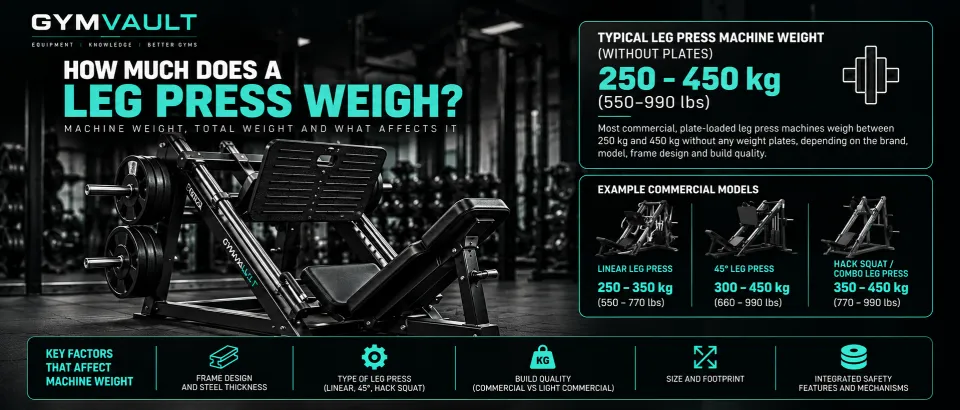
Ask ten people in a gym how much an empty leg press weighs and you may hear ten different numbers. Each of them may be right about their own machine. A plate-loaded leg press is never really empty: even with no plates on it, you are moving a sled or a pair of lever arms, and that starting load depends entirely on how the machine was designed.
This article collects what manufacturers actually publish, explains why the angle of the machine matters as much as the numbers on the plates, and shows why a leg press number does not convert into a squat number.
The short answer
- Sled-style 45-degree leg presses: the commercial machines below publish starting figures between 45 kg and 80 kg.
- Some older designs start much lower. Two discontinued Hammer Strength leg presses list 6.3 kg (an Iso-Lateral model with independent lever arms) and 9.5 kg.
- Pin-loaded (selectorized) leg presses have no plates to add. You choose the load on the weight stack.
If you need the figure for a particular machine, find its make and model and check the manufacturer's specification sheet. The table below shows why guessing does not work.
What manufacturers publish
| Machine | Design | Published starting figure |
|---|---|---|
| Panatta Super Leg Press 45° (1FW086) | 45° sled | "Starting load" 80 kg |
| Matrix Magnum 45 Degree Leg Press (MG-PL70) | 45° sled | "Starting resistance" 75.7 kg / 167 lb |
| Precor Discovery Series Plate Loaded Angled Leg Press (DPL0601) | 45° sled | "Starting weight" 136 lb / 62 kg |
| Hammer Strength Plate-Loaded Linear Leg Press (HSLLP) | 45° sled | "Starting resistance" 118 lb (53 kg) |
| Life Fitness Plate Loaded Linear Leg Press (SPLLLP) | Linear sled, angle not stated | "Starting resistance" 103 lb (47 kg) |
| Nautilus Leverage Premier Angled Leg Press (NP-L1141) | 45° sled | "Carriage weight" 100 lb (45 kg) |
| Hammer Strength Plate-Loaded Leg Press (PL-LP), discontinued | Not described | "Starting resistance" 21 lb (9.5 kg) |
| Hammer Strength Plate-Loaded Iso-Lateral Leg Press (IL-LP), discontinued | Independent lever arms | "Starting resistance" 14 lb (6.3 kg) |
| Cybex Plate Loaded Leg Press (16110), discontinued | Not described | No figure on the product page or in the owner's manual |
Figures are quoted as each manufacturer publishes them, from the product pages, sell sheets and manuals listed in the references, checked in October 2026. The Matrix figures come from a Johnson Fitness & Wellness product page.
Three cautions before you use these numbers:
- The labels differ. "Starting load", "starting resistance", "starting weight" and "carriage weight" are each manufacturer's own words. None of these pages says whether its figure is the sled's mass or the force you feel along the rails, so treat them as each maker's own description rather than like-for-like measurements.
- Older machines still matter. Discontinued models stay in gyms, and on the pre-owned market, for years. That is why the table includes them.
- Unlisted machines need measuring. If your machine comes from a manufacturer that publishes no figure, or you cannot identify the model, only the maker or a measurement will tell you its starting load.
Why the angle matters
On a 45-degree leg press you do not push the plates straight up. You push them along a tilted track. Basic mechanics says that on a slope at an angle θ to the horizontal, the part of an object's weight that acts along the slope is its weight multiplied by sin θ (OpenStax, 2020). The rest of the weight presses the sled into its rails.
| Track angle from horizontal | Share of the plates' weight acting along the track |
|---|---|
| 30° | 50% |
| 35° | 57% |
| 40° | 64% |
| 45° | 71% |
| 90° (vertical) | 100% |
So 100 kg of plates on a 45-degree sled puts about 71 kg along the track. Friction then adds a little resistance on the way up and takes a little away on the way down. How much depends on the bearings, the rails and how well the machine has been maintained.
This is also why you should not apply the 71% to the manufacturers' starting figures. Without knowing whether a figure is the sled's mass or the force along the rails, you could end up discounting it twice.
What one measured machine showed
Few studies have measured what a lifter actually pushes on a leg press. One conference abstract did: a load cell was mounted in line with the sled's travel on a commercial leg press, and plates were added in steps (Clemons, 2010). With no plates at all, the lifter had to overcome 49.6 kg to move the sled. Across the loads tested, the measured resistance followed a straight line: about 0.64 kg for each kilogram of plates, plus a little over 50 kg for the sled.
| Plates loaded | Resistance, from the study's equation |
|---|---|
| 0 kg | 50 kg |
| 40 kg | 76 kg |
| 100 kg | 114 kg |
| 140 kg | 140 kg |
| 200 kg | 178 kg |
| 300 kg | 242 kg |
Two things stand out. At light loads, the sled makes the machine heavier than the plates suggest. At heavy loads, the angle makes it lighter, and the gap grows with every plate. On this machine the two effects cancelled out at about 140 kg.
This was one machine, the abstract does not report its angle, and a conference abstract is not a full peer-reviewed paper. The pattern, though, is the one the physics predicts.
How to estimate your own number
- Identify the machine. Look for the manufacturer's name and the model on the frame or on a serial label.
- Find the published starting figure on the manufacturer's specification sheet for that model.
- Work out the plates' share. Multiply the weight of the plates by the share for the machine's angle: about 0.71 at 45 degrees.
- Add the two together and treat the result as an estimate, not a precise reading.
For example, four 20 kg plates on each side of a Hammer Strength Linear Leg Press is 160 kg of plates. At 45 degrees, about 113 kg of that acts along the track. Hammer Strength lists the starting resistance as 118 lb (53 kg). If that figure is the force along the rails, the total is about 166 kg. If it is the sled's mass, the sled adds about 38 kg along the track and the total is about 151 kg. Either way you are pushing roughly 150 to 166 kg, not the 213 kg you get by adding the plates to the published starting figure.
If you own the machine, measure it
A gym that wants to post an accurate starting figure on a machine can measure it. Hook a calibrated hanging scale, rated well above the expected load, to the footplate. Pull the sled slowly up the track, parallel to the rails, and note the reading. Then let it down just as slowly and note the reading again. Friction raises the first reading and lowers the second, so the average of the two is a fair estimate of the sled's load along the track. Keep the safety stops set, and keep hands and feet clear of the sled's path.
Hack squats and Smith machines
The same questions come up on the two other machines people use to compare leg strength.
Hack squats. Published starting figures vary just as much:
| Machine | Published starting figure |
|---|---|
| Hammer Strength Plate Loaded Hack Squat (PL-HSQ2), 45° | "Starting resistance (per arm)" 125 lb (57 kg), as worded on the US page |
| Matrix Magnum Hack Squat (MG-PL71) | "Starting resistance" 47.6 kg / 105 lb |
| Panatta Hack Squat (1FO087) | "Empty load" 40 kg |
| Nautilus Leverage Premier Hack Squat (NP-L1130), 35° | "Carriage weight" 80 lb (36 kg) |
| Cybex Plate Loaded Hack Squat (16200) | No figure in the owner's manual |
On a hack squat you also ride on the sled, so part of your own body weight moves with it, and the machine's angle again changes how much of the plates' weight you push. That is one reason hack squat numbers are not squat numbers. In one study, ten strength-trained men lifted an average of 171 kg on a 45-degree plate-loaded hack squat, against 142 kg on the barbell back squat (Clark et al., 2019).
Smith machines. A Smith machine bar runs on guides, and many are lighter than the 20 kg Olympic bar most people assume:
| Machine | Published bar figure |
|---|---|
| Hammer Strength Smith Machine (HSSM) | "Starting resistance" 30 lb (13.6 kg) |
| Matrix Magnum Smith Machine (MG-PL62) | Counterbalanced, "starting resistance" 11.3 kg / 25 lb |
| Life Fitness Signature Series Smith Machine (SSM) | "Bar weight" 20 lb (9 kg) |
| Cybex Plate Loaded Smith Press (16121) | "Unloaded bar weight" 15 lb (7 kg) |
A counterbalanced Smith machine offsets part of the bar's weight, so its starting resistance is lower than the bar's own mass. Bar paths differ too: Life Fitness lists a 7-degree bar angle for its Signature Series Smith, while Matrix describes a 90-degree path of motion. The path changes how a squat feels, which we look at in Smith machine vs barbell squat.
Pin-loaded machines. On a selectorized leg press, the number you pin on the stack is what you choose, but cables, pulleys and sometimes cams sit between the stack and the footplate. Some manufacturers state the ratio: Nautilus, for example, describes its Impact Seated Leg Press as having "a true 1:1 weight ratio". We explain ratios in Cable machine pulley ratios explained, cams in How strength machines load your muscles, and the two machine types in Plate-loaded vs pin-loaded machines.
Why your leg press is so much bigger than your squat
Most people can leg press far more than they can squat. Several things explain the gap:
- The angle. On a 45-degree sled, only about 71% of the plates' weight acts along the track.
- Your body weight. In a squat you lift your own body as well as the bar. On a leg press your body stays on the seat, and only your legs move.
- Support and balance. The leg press supports your back and needs no balance. In a squat your trunk has to hold the load: in Clark et al. (2019), trunk muscle activation was higher in the back squat than in the hack squat at the same relative loads.
- Range of motion. On a leg press the seat setting and how deep you go set the range, and it is easy to shorten without noticing.
- Different skills. Strength is specific to the movement you train. In a 10-week study of 26 untrained or detrained men, those who trained only the squat improved their squat by 76.2 kg on average, against 21.1 kg in those who trained only the leg press. Leg press strength improved by a similar amount in every group (Rossi et al., 2018).
So a leg press number is not a squat number, and there is no reliable conversion between them. The muscles work differently too: in a laboratory comparison, the squat produced more quadriceps and hamstring activity than two leg press variations (Escamilla et al., 2001). Muscle activity is not the same as muscle growth, and we compare the machines in more depth in Hack squat vs leg press.
What this means in practice
For lifters:
- Compare your numbers only on the same machine, and write the machine's name in your training log.
- When you change gyms, expect your leg press numbers to change. That says little about your strength.
- Judge progress by more weight or more repetitions on the same machine, with the same seat setting and depth. We cover this in Progressive overload: what it means and how to apply it.
For gym owners and buyers:
- Post each plate-loaded machine's published or measured starting figure on its frame, so members can log their training accurately.
- When buying a pre-owned leg press or hack squat, confirm the exact model, look up its published figures, and check the sled's travel, bearings and safety stops before you agree a price. Our inspection guide covers what to look for.
- A heavier or lighter starting load is not better in itself. A light start suits beginners and lighter users, and a heavy sled suits strong lifters who would otherwise need a lot of plates.
- For the rest of the gym floor, see our commercial gym equipment list.

The bottom line
An "empty" leg press is never empty. Depending on the model, the starting load runs from a few kilograms to 80 kg, and the angle means you push only part of what you load. Treat every leg press, hack squat and Smith machine number as specific to its machine, and judge progress on the same machine over time.
References
- Clark DR, Lambert MI, Hunter AM. Trunk muscle activation in the back and hack squat at the same relative loads. J Strength Cond Res. 2019;33(Suppl 1):S60–S69. doi:10.1519/JSC.0000000000002144
- Clemons J. Relationship between plate mass and actual leg press loads (conference abstract). J Strength Cond Res. 2010;24(Suppl 1):1. doi:10.1097/01.JSC.0000367085.50510.c6
- Escamilla RF, Fleisig GS, Zheng N, et al. Effects of technique variations on knee biomechanics during the squat and leg press. Med Sci Sports Exerc. 2001;33(9):1552–1566. doi:10.1097/00005768-200109000-00020
- OpenStax. Physics, section 5.4: Inclined planes. OpenStax; 2020. openstax.org
- Rossi FE, Schoenfeld BJ, Ocetnik S, et al. Strength, body composition, and functional outcomes in the squat versus leg press exercises. J Sports Med Phys Fitness. 2018;58(3):263–270. doi:10.23736/S0022-4707.16.06698-6
- Panatta. Super leg press 45° (1FW086), checked October 2026. panattasport.com
- Matrix Magnum 45 Degree Leg Press (MG-PL70), product page, checked October 2026. johnsonfitness.com
- Precor. Discovery Series Plate Loaded Angled Leg Press (DPL0601), sell sheet, checked October 2026. static.precor.com
- Life Fitness. Hammer Strength Plate Loaded Linear Leg Press (HSLLP), checked October 2026. lifefitness.com
- Life Fitness. Life Fitness Plate Loaded Linear Leg Press (SPLLLP), checked October 2026. lifefitness.com
- Core Health & Fitness. Nautilus Leverage Premier Angled Leg Press (NP-L1141), checked October 2026. corehandf.com
- Life Fitness. Hammer Strength Plate-Loaded Leg Press (PL-LP), discontinued, checked October 2026. lifefitness.com
- Life Fitness. Hammer Strength Plate-Loaded Iso-Lateral Leg Press (IL-LP), discontinued, checked October 2026. lifefitness.com
- Cybex. Plate Loaded Leg Press 16110, owner's manual, checked October 2026. kb.cybexintl.com
- Life Fitness. Hammer Strength Plate Loaded Hack Squat (PL-HSQ2), checked October 2026. lifefitness.com
- Matrix Magnum Hack Squat (MG-PL71), product page, checked October 2026. johnsonfitness.com
- Panatta. Hack squat (1FO087), checked October 2026. panattasport.com
- Core Health & Fitness. Nautilus Leverage Premier Hack Squat (NP-L1130), product sheet, checked October 2026. corehandf.com
- Cybex. Plate Loaded Hack Squat 16200, owner's manual, checked October 2026. kb.cybexintl.com
- Life Fitness. Hammer Strength Smith Machine (HSSM), checked October 2026. lifefitness.com
- Matrix Magnum Smith Machine (MG-PL62), product page, checked October 2026. johnsonfitness.com
- Life Fitness. Signature Series Smith Machine (SSM), checked October 2026. lifefitness.com
- Cybex. Plate Loaded Smith Press 16121, owner's manual, checked October 2026. kb.cybexintl.com
- Core Health & Fitness. Nautilus Impact Seated Leg Press (9NA-S1305), checked October 2026. corehandf.com
Further reading
- How strength machines load your muscles
- Resistance curves and why the cam matters
- Hack squat vs leg press: which builds bigger legs?
- Browse leg machines
- Browse plate-loaded machines
This article is general information about training and equipment. It is not medical advice. Speak to a qualified professional before starting a new exercise programme, particularly if you have an injury, a health condition or have been inactive.